

Adults need around 150 µg of iodine a day for healthy thyroid function, and the safe upper limit sits at 1,100 µg a day. The real danger for most people isn’t deficiency, it’s an unmonitored high-dose supplement or a kelp product that packs in far more iodine than the label suggests. If you’re pregnant, breastfeeding, or already managing a thyroid condition, check the microgram figure on anything you take and speak to your GP or endocrinologist before changing your intake.
TL;DR:
- Most adults should avoid supplements delivering more than 500 µg of iodine daily unless specifically recommended by a healthcare professional.
- Food sources like seafood, dairy, and iodized salt typically provide sufficient iodine, but kelp and seaweed products often contain unpredictable, excessive amounts.
- Pregnant, breastfeeding, and individuals with autoimmune or other thyroid conditions must consult their doctor before using iodine supplements due to heightened sensitivity.
- Regular monitoring of thyroid function and iodine intake is crucial for those with existing thyroid issues or on thyroid medication to prevent adverse effects.
- Standardized potassium iodide supplements with clear microgram doses are the safest option for supplementation, especially when aiming to stay below the 500 µg daily threshold.
Table of Contents
- How much iodine is safe for thyroid health?
- Who is most at risk from too much or too little iodine?
- Where does iodine come from, and where are the hidden risks?
- How to use iodine supplements safely
- What if you already have a thyroid condition?
- How do you check your iodine and thyroid status?
- Why Live5dhealth leads with caution on iodine
- Where to find standardised iodine supplements
- Sources
- FAQ
How much iodine is safe for thyroid health?
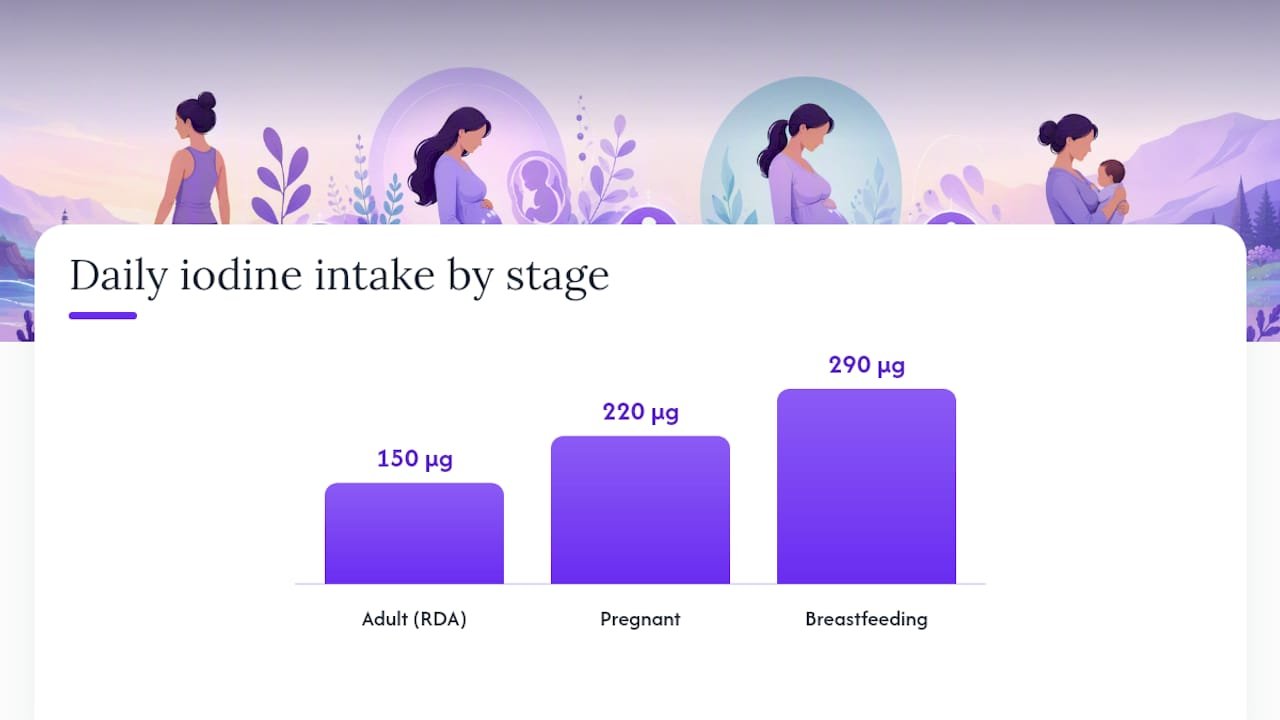
Your thyroid needs a steady, moderate supply of iodine, not a flood of it. The Harvard T.H. Chan School of Public Health sets the adult RDA at 150 µg per day, rising to 220 to 290 µg per day for women who are pregnant or breastfeeding, since the developing baby relies entirely on maternal iodine stores for its own thyroid hormone production.
The tolerable upper intake level, or UL, is 1,100 µg per day for adults. Go above that consistently and you risk tipping your thyroid out of balance rather than supporting it. The American Thyroid Association goes further, cautioning against supplements delivering more than 500 µg a day for most people, since that’s well below the UL yet still enough to interfere with normal thyroid regulation in sensitive individuals.
Following one consistent set of figures matters more than chasing the highest number you’ve seen online. Iodine needs shift with life stage and existing thyroid health, so a target that’s right for a healthy adult may be wrong for someone pregnant or living with Hashimoto’s.
Who is most at risk from too much or too little iodine?
Some groups need real caution before touching an iodine supplement, whether they’re worried about deficiency or excess. Pregnant and breastfeeding women sit at the top of that list, because a developing baby’s thyroid is immature and highly sensitive to both shortfall and overload. Infants follow closely behind for the same reason.
People with autoimmune thyroid disease, such as Hashimoto’s thyroiditis or Graves’ disease, are particularly vulnerable to iodine-triggered adverse effects and should only use iodine supplements under medical supervision according to research from Queen’s University Belfast. Those with nodular thyroid disease, kidney disease, or older adults with any pre-existing thyroid irregularity also need oversight, partly because some thyroids fail to “escape” the temporary shutdown iodine triggers after a large dose, leading to sustained underactivity instead of a quick bounce back.
- Pregnant or breastfeeding women
- Infants and young children
- Anyone with autoimmune thyroid disease
- People with thyroid nodules or existing thyroid dysfunction
- Those with kidney disease or advanced age
Pro Tip: If you fall into any of these groups and are considering an iodine supplement, ring your GP or midwife before you start, not after you’ve been taking it for a month.
Where does iodine come from, and where are the hidden risks?
Most people get iodine without thinking about it. Seafood, dairy products, and iodised salt are the everyday backbone of intake, though anyone eating mostly plant-based or actively cutting salt may be getting considerably less than they assume, a shift flagged in recent dietary reviews tracking how changing eating patterns affect population iodine status.
The hidden risks sit elsewhere, often in places people don’t think to check:
- Kelp and seaweed supplements. Content varies wildly between brands and batches, and many deliver several times the UL in a single capsule.
- Concentrated iodine or potassium iodide supplements. Some over-the-counter products contain doses meant for short-term clinical use, not daily supplementation.
- Iodinated contrast dye used in CT scans and some medical imaging, which can affect thyroid function for months afterwards.
- Amiodarone, a heart medication with a very high iodine content.
- Large-scale topical iodine use, such as repeated antiseptic application over broken skin.
Read the label on any supplement before you buy it, and if you’ve had a contrast scan or take amiodarone, mention it at your next thyroid check.
How to use iodine supplements safely
Before adding a supplement, work out roughly what you’re already getting from food. If you eat dairy, seafood, or iodised salt regularly, you may not need to supplement at all.
- Read the microgram dose on the label, not just the ingredient name.
- Avoid anything delivering more than 500 µg per day unless a clinician has specifically recommended it.
- Choose standardised potassium iodide over unstandardised kelp or seaweed extracts, since kelp content is notoriously inconsistent between brands, as a review of supplement iodine content has shown.
- If you’re planning a pregnancy or already pregnant, the NIH Office of Dietary Supplements recommends a prenatal multivitamin containing 150 µg of potassium iodide specifically, rather than a generic high-dose iodine product.
Pro Tip: A supplement labelled “iodine complex” or “sea kelp blend” rarely states a precise microgram figure. If you can’t find a clear number on the packaging, that’s a reason to put it back on the shelf. For a fuller walkthrough of dosing and product selection, Live5dhealth’s guide to safe iodine use covers the practical detail in more depth.
What if you already have a thyroid condition?
If you’re on levothyroxine or an antithyroid medication, extra iodine isn’t a neutral addition, it’s a variable that can shift how well your treatment works. A sudden, large iodine load can trigger the Wolff–Chaikoff effect, a temporary block on thyroid hormone production, and in people with autoimmune or nodular thyroid disease, the thyroid sometimes fails to recover from that block on schedule, leading to prolonged hypoactivity, according to NCBI’s clinical review of iodine and thyroid function. In others, particularly those with nodular goitre, the opposite can happen: excess iodine triggers overactivity, known as the Jod-Basedow effect.
- Tell every prescriber about supplements you’re taking, including multivitamins with added iodine.
- Defer new iodine supplementation until your endocrinologist has reviewed your current dose and thyroid function tests.
- Ask about monitoring after any iodinated contrast scan, since effects can surface months later rather than immediately.
- Watch for new palpitations, weight changes, or fatigue after starting any iodine-containing product, and report them promptly.
How do you check your iodine and thyroid status?
Testing iodine status is trickier than most people expect. Spot urinary iodine concentration is a solid population-level marker, but it fluctuates so much day to day in one person that a single test tells you little about your own status.
Blood tests give a clearer individual picture, though even these have blind spots. TSH is the standard first check, but it isn’t always sensitive to early iodine-related thyroid stress, which is why the Harvard Nutrition Source recommends pairing it with T4, T3, and thyroid antibody testing rather than relying on TSH alone.
A sensible sequence looks like this:
- Start with a symptom review with your GP: fatigue, weight change, neck swelling, palpitations.
- Request baseline TSH, free T4, and thyroid antibodies if there’s any history of thyroid disease.
- Only pursue urinary iodine testing or specialist referral if results are unclear or symptoms persist.
Why Live5dhealth leads with caution on iodine
Iodine does more than fuel thyroid hormone production. Emerging research points to antioxidant and antimicrobial roles too, but that broader physiology is not a licence to chase higher doses. This guidance is written to be practical enough to act on, cautious enough to send you to a GP or endocrinologist when your situation calls for it. Anyone pregnant, breastfeeding, or managing thyroid disease should treat medical supervision as the starting point, not an afterthought.
— Mark
Where to find standardised iodine supplements
Once you’ve worked out that supplementation makes sense for you, the next question is dosing consistency. Many kelp-based products on general retail shelves carry no reliable microgram figure at all, which makes it almost impossible to stay safely under the 500 µg caution threshold. Live5dhealth’s iodine product range is built around standardised dosing, so what’s on the label is what’s in the capsule, letting you track your intake against the RDA and UL with actual confidence.

If you’re pregnant, breastfeeding, or currently being treated for a thyroid condition, use these products alongside advice from your GP or endocrinologist rather than in place of it. For a full breakdown of dosing options and how to choose the right product for your situation, visit the iodine supplement guide and browse the current range to find a starting point that matches your daily target.
This article is general information, not a substitute for advice from a qualified doctor. Consult a qualified healthcare professional about your own circumstances before acting on anything here.
Sources
- The Nutrition Source — Iodine (Harvard T.H. Chan School of Public Health)
- Iodine — NIH Office of Dietary Supplements
- Iodine and thyroid function — NCBI Bookshelf
- High iodine in supplements and risks (PMC review)
- Iodine in health and disease — MDPI review (2026)
FAQ
Is 150 µg of iodine a day safe for everyone?
Yes, 150 µg is the RDA for non-pregnant adults, but pregnant and breastfeeding women need more, around 220 to 290 µg a day, so the same figure isn’t right for every life stage.
Can too much iodine damage the thyroid?
Yes, regularly exceeding the 1,100 µg upper limit can trigger thyroid dysfunction, including goitre and thyroiditis, and people with existing thyroid disease can react to even lower doses.
Is kelp a safe way to get iodine?
Not reliably. Kelp and seaweed supplement content varies enormously between products, and many deliver several times the safe upper limit in a single dose.
Should I get tested before taking an iodine supplement?
If you’re pregnant, have thyroid disease, or take thyroid medication, yes, a baseline TSH, free T4, and antibody panel gives your clinician the context needed before you add iodine.
What’s the safest way to start iodine supplementation?
Choose a standardised potassium iodide product with a clear microgram dose, stay below 500 µg daily without medical advice, and check with your GP first if you’re in a higher risk group.