
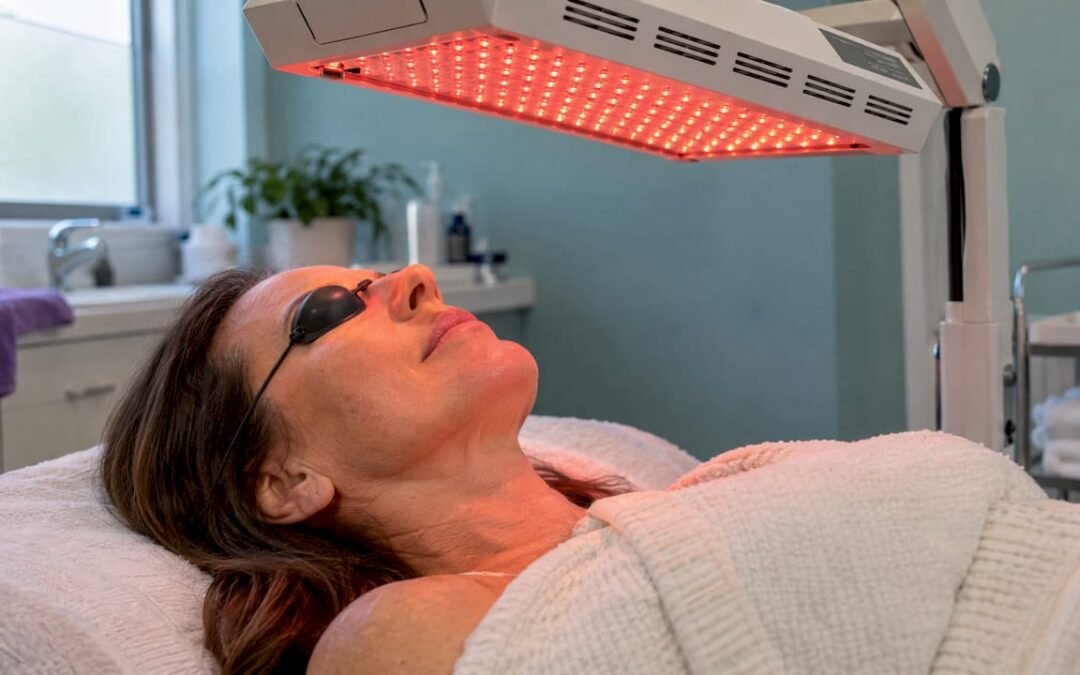
Red light therapy uses gentle red and near-infrared light to support the skin’s own repair processes. Research suggests it can help soften fine lines and wrinkles, smooth texture, calm redness and ease acne. It works gradually: visible change usually takes regular sessions over several months, not a single visit. Below, we explain what a red light facial involves, what the evidence says, who should speak to a doctor first, and how to get the most from your sessions in Ireland.
TL;DR
- Red light therapy (photobiomodulation) is believed to stimulate the mitochondria in skin cells, reduce inflammation and support collagen production, according to Harvard Health.
- The American Academy of Dermatology says research suggests it can help with fine lines, wrinkles, texture, redness and acne.
- Expect a slow, cumulative effect: regular sessions over four to six months is the pattern the AAD describes.
- It does not emit UV light, and side effects are usually mild and temporary. Eye protection and your doctor’s advice matter if you have a light-sensitive condition, take photosensitising medication or have a history of cancer.
- At Live5DHealth, red light therapy sessions are €20 to €40 per session at our Boyle, County Roscommon centre.
Table of Contents
- What red light therapy for skin actually is
- The skin benefits you can reasonably expect
- Red light therapy for skin over 40
- How often, and when you might notice results
- Safety, side effects and who should check first
- At home or in a centre?
- Getting more from every session
- Book red light therapy in Boyle, County Roscommon
- FAQ
- Sources
What red light therapy for skin actually is
Red light therapy, also called photobiomodulation, uses devices that give off red or near-infrared light aimed at the skin. The light contains no ultraviolet rays, so it is a different thing altogether from a sunbed or sun exposure. Harvard Health explains that it is believed to act on the mitochondria, the small structures inside cells often called the powerhouse of the cell, helping them produce energy while reducing inflammation and encouraging collagen production.
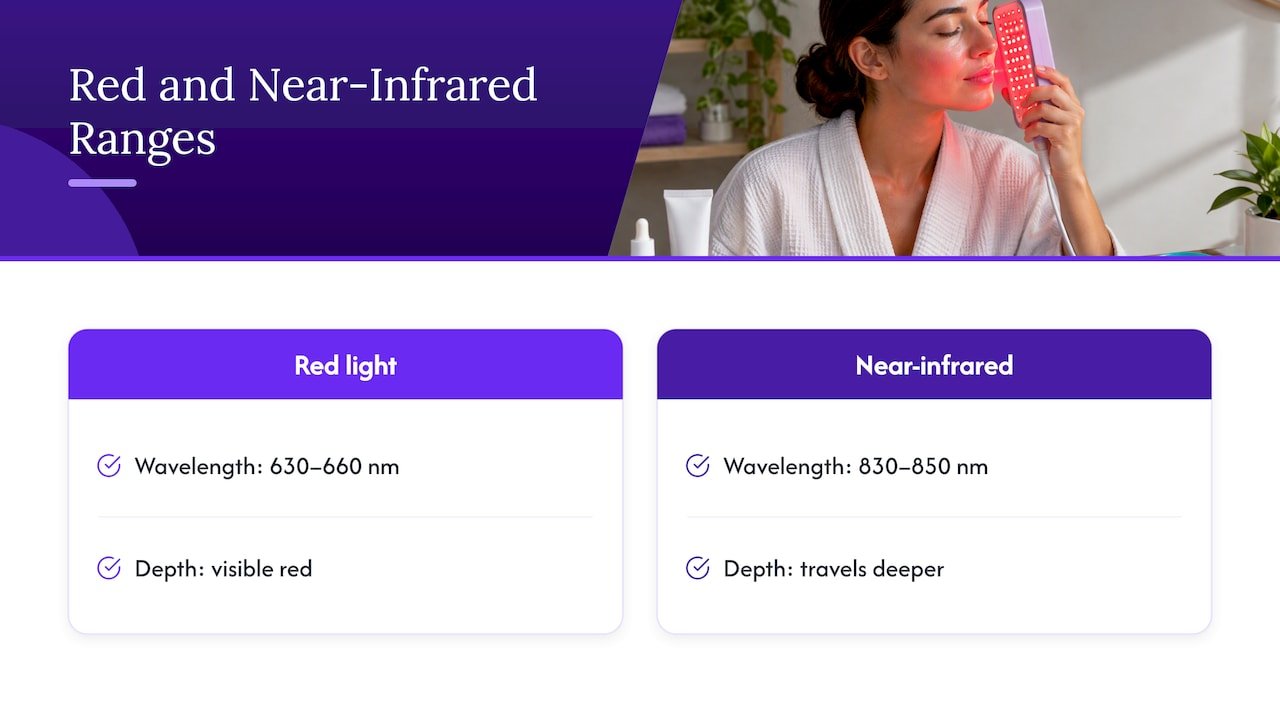
Collagen is the protein that gives skin its firmness and spring. Red light is thought to nudge the cells that make it. Near-infrared light travels a little deeper than visible red light, which is why many treatments use both. If you want to understand the two ranges in detail, our guide to red light wavelengths explains how 630 to 660 nm and 830 to 850 nm differ in use.
What happens during a red light facial
A red light facial is simple and comfortable. You sit or lie back with a clean, make-up-free face, put on eye protection, and a panel or mask delivers light to the skin for a set number of minutes. There is no downtime, no peeling and nothing to recover from. Most people feel gentle warmth at most.
Because there is no needle, acid or heat damage involved, many people use it alongside their normal skincare. Harvard Health notes that red light therapy complements, but does not replace, other skin-savvy measures, and daily sunscreen remains the foundation.
The skin benefits you can reasonably expect
The AAD’s summary is that research suggests red light therapy can reduce fine lines and wrinkles, smooth skin texture, diminish redness and ease acne. It also notes that some studies of red-light LED devices show subtle to noticeable results for dark spots, rough-feeling skin and loose skin.
Here is how that translates into everyday terms:
- Fine lines and wrinkles: the most common reason people book. The aim is a softer, fresher look over time, not an overnight change.
- Texture: skin that feels smoother and less rough.
- Redness: calmer-looking skin, which is why some people explore it for sensitive complexions. Our page on red light therapy for rosacea looks at that evidence specifically.
- Blemishes: the AAD lists acne among the concerns where research suggests benefit.
- Scars and cellulite: these are separate topics, covered in our guides to red light for scars and red light therapy for cellulite.
An honest view of the evidence
The science is encouraging and still developing. A Stanford Medicine dermatologist, Dr Zakia Rahman, has said red light has evidence for hair growth and reducing tissue inflammation, while pointing out that results depend on treatment strength and duration, which are often unknown with home devices. A 2026 review in the Journal of Drugs in Dermatology also observes that consumer marketing can run ahead of the clinical data.
The practical lesson is to choose a provider who is open about how a session is delivered and to set realistic expectations. Dose matters, which is why we have written about measuring irradiance and dosage.
Red light therapy for skin over 40
Many of the women who come to us are in their forties, fifties and beyond. They are often looking for something gentle that fits around the skincare they already use, and that does not involve injections or downtime. The concerns they name most often are fine lines, uneven tone, dullness and skin that looks tired or flushed.
Those are the same areas the AAD associates with possible benefit: fine lines, wrinkles, texture, redness, dark spots and looseness. Red light is not a facelift and it will not stop time. What it can offer is a supportive, low-risk routine that works with your skin’s own repair processes. Consistency matters more than intensity, and the most helpful habits are usually the simple ones:
- Keep sessions regular rather than occasional.
- Cleanse before each session so light reaches the skin without make-up or heavy products in the way.
- Continue daily sun protection.
- Take a photo in the same light every few weeks, so you can judge progress honestly.
Around menopause, skin often becomes drier and more sensitive. If that is you, tell your therapist before the first session so that your routine can be built around comfort.
How often, and when you might notice results
This is where most people are surprised. According to the AAD, treatment typically requires consistent use several times a week for four to six months to achieve visible results. Effects are slow and cumulative, so a steady, long-term schedule beats expecting instant change.
In practice, think in three stages:
| Stage | What to focus on |
|---|---|
| First few weeks | Learn the routine, check how your skin feels, note any irritation |
| Months two to three | Look for small shifts in texture and calmness using your photos |
| Months four to six | Judge visible change in lines, tone and redness against your starting point |
Our practical guide to using red light therapy covers session length and spacing in more detail.
Safety, side effects and who should check first
The AAD says side effects may include temporary mild pain or irritated skin. It advises following the device directions and wearing eye protection if they recommend it. If you have a light-sensitive condition, or take medication that increases skin sensitivity, consult a dermatologist before starting.
Two of our guides go deeper on this: red light therapy side effects and eye safety for red light. Read them if you are new to the therapy.
Can you overdo it? More is not automatically better. Because the safest and most effective amount of light remains uncertain for home use, staying within the session times and frequency your provider or device maker sets is the sensible approach. If skin becomes red, sore or tight, pause and speak to a dermatologist or pharmacist.
Red light therapy and a history of cancer
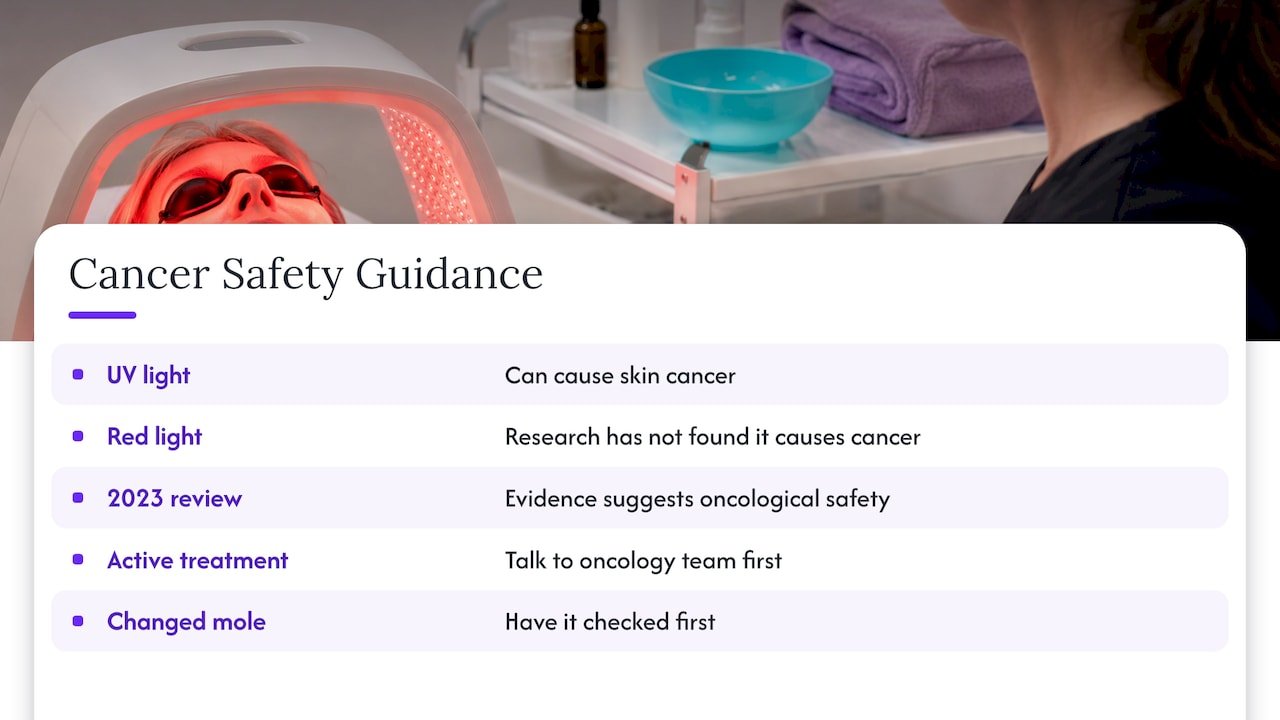
Many of our guests are living with or recovering from cancer, and this is a fair question. The AAD states that, unlike ultraviolet light, which can cause skin cancer, research has not found that red light can cause any type of cancer. A 2023 systematic review concluded that current clinical and preclinical evidence suggests photobiomodulation is oncologically safe for skin rejuvenation and does not support avoiding it in patients previously treated for cancer.
Even so, your situation is individual. If you are in active treatment, have had melanoma or have a mole or patch that has changed, talk to your oncology team or dermatologist before booking, and have any suspicious lesion checked first. Skin that is being treated or protected also needs care outdoors, and the same thinking applies to any pigmented skin: this piece on scalp micropigmentation and sun exposure shows how UV protection preserves pigment, which is a useful reminder that sun care and light therapy are separate things.
At home or in a centre?
You can use red light at home. The AAD notes that home devices commonly use LEDs, and some use low-level lasers, and that dermatologists’ devices are more powerful. It recommends seeing a board-certified dermatologist before use and choosing an FDA-cleared device, which is a US standard, so in Ireland it is worth asking your dermatologist or pharmacist what to look for.
What a centre adds is guidance and convenience:
- Someone to talk through your skin concerns, medication and health history first.
- Professional eye protection and a consistent setup each visit.
- No device to buy up front, which suits people who want to try the therapy before committing to equipment.
- The option to combine it with other recovery therapies in the same visit.
For a wider overview of what is available locally, see our complete guide to red light therapy in Ireland.
Our perspective
We see red light therapy as one of the most approachable ways to look after your skin, and a natural starting point for anyone new to advanced wellness technology. It is gentle, it carries no UV, and it asks nothing of you except regularity.
At Live5DHealth, we believe skin reflects the whole body. That is why our approach is holistic: we combine state-of-the-art technology with ancient wisdom, and we offer red light alongside therapies such as hyperbaric oxygen, PEMF, holistic massage and our sauna, steam room and cold plunge spa. A woman over 40 who comes in for a red light facial often finds that the calm, unhurried time is as valuable as the light itself.
Our advice is simple. Start with a routine you can keep. Be patient, because skin changes slowly. Protect it from the sun every day. Tell us about your health history so we can tailor your visits. Your best skin is built on consistency, and we are here to help you stay on course.
Mark
Getting more from every session
Small habits make a difference to how comfortable and consistent your routine feels.
- Arrive with clean skin. Remove make-up and heavy creams. The skin should be bare so light is not blocked.
- Hydrate. Drink water before and after. At our centre, members have access to free energised water.
- Wind down. Pair a session with a visit to the sauna or steam room if you enjoy it, and finish with some quiet time.
- Keep a record. Photos, a note of how skin feels and any products you start or stop all help you read your results.
- Layer with care. If you use retinoids, acids or any prescription skincare, ask your pharmacist or dermatologist how to time them around sessions.
For people who like to understand the biology, our page on red light and mitochondria explains the cellular side.
Book red light therapy in Boyle, County Roscommon
If you would like to try red light for your skin, our red light therapy sessions are €20 to €40 per session. We will talk through your skin goals and health history, then set up a routine that suits you.
If you would like a full day of care, our sauna, steam and cold plunge spa is €30 and pairs well with a light therapy session. Coming with friends or family? We also take group bookings. You can see the full range of therapies on our home page.
FAQ
Is a red light facial safe?
For most people, yes. Red light contains no UV, and the AAD lists temporary mild pain or irritated skin as possible side effects. Wear eye protection if recommended, and consult a dermatologist first if you have a light-sensitive condition or take medication that makes skin more sensitive.
How long does it take to see results from red light for skin?
The AAD describes consistent use several times a week for four to six months to reach visible results. Changes are gradual and build up, so photos taken at regular intervals help you notice them.
Can red light therapy be used after cancer treatment?
A 2023 systematic review found current evidence suggests photobiomodulation is oncologically safe for skin rejuvenation, and did not support avoiding it in people previously treated for cancer. Because every case differs, speak to your oncology team or dermatologist first, especially if you have had melanoma or have any suspicious skin lesion.
Can I do red light therapy at home?
Yes, with LED devices, which are less powerful than those used by dermatologists. The AAD advises seeing a board-certified dermatologist beforehand and notes the safest and most effective amount of light at home is still uncertain, so follow the device directions closely.
Can you overdo red light therapy?
More light is not necessarily better, and the ideal home dose is uncertain according to the AAD. Stay within the recommended session length and frequency, and pause and seek advice if your skin becomes sore or irritated.
Sources
- Red light therapy for skin care, Harvard Health
- Is red light therapy right for your skin?, American Academy of Dermatology
- Red light therapy: What the science says, Stanford Medicine
- Red Light Therapy in Cosmetic Dermatology: Marketing Claims and Evidence, Journal of Drugs in Dermatology
- Photobiomodulation: A Systematic Review of the Oncologic Safety, PubMed Central
- Scalp micropigmentation and sun exposure