
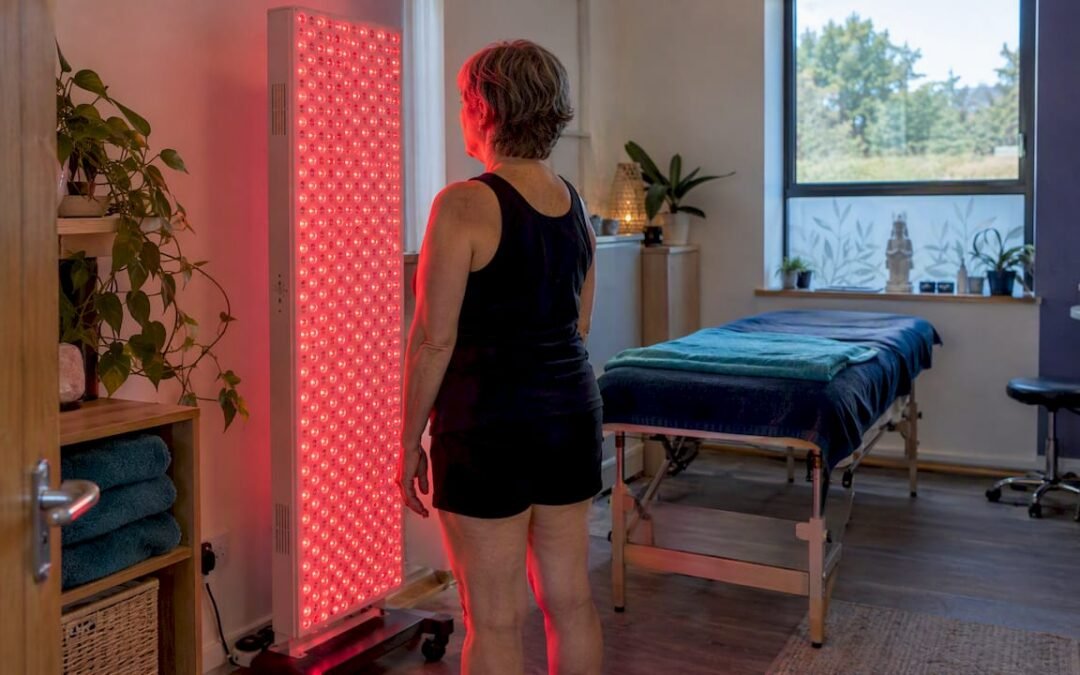
Red and near-infrared light act on mitochondria by targeting cytochrome c oxidase, which can increase ATP production and trigger protective cellular signalling. The effect depends heavily on wavelength and dose, so not every red light exposure delivers the same result. Below, we walk through the mechanisms, the strongest human evidence, and how to apply this safely.
TL;DR:
- Use 630 to 670 nm red light for superficial targets and 810 to 850 nm near infrared for deeper tissue; check irradiance before timing sessions.
- A controlled human trial found that 15 minutes of 670 nm light reduced the postmeal glucose rise by 27.7%, but metabolic use remains emerging.
- Muscle cell experiments found ATP and membrane potential peaked 3 to 6 hours after exposure, so preexercise sessions may work better several hours beforehand.
- Because excess exposure can blunt benefits, follow device distance and timing guidance; consult a doctor first if pregnant, taking photosensitizing medication, or receiving cancer treatment.
Table of Contents
- Cellular mechanisms: how red and near-infrared photons change mitochondrial function
- Human and lab studies that quantify ATP, metabolic and clinical outcomes
- Which wavelengths and doses are used, and how do you calculate treatment time?
- When should you use red light for recovery or pre-exercise priming?
- What outcomes does red light therapy plausibly improve?
- How do you use red light therapy safely?
- Live5D Health guidance on safe, measured red light sessions
- How does red light therapy compare with hyperbaric oxygen and PEMF?
- How does red light therapy fit into a wider wellness routine?
- What are the common misconceptions about red light and mitochondria?
- How do you choose a red light device for home use?
- Why individualised care still matters alongside the evidence
- Book a measured red light therapy session with us
- FAQ
- Sources
Cellular mechanisms: how red and near-infrared photons change mitochondrial function
Mitochondria are often called the powerhouse of the cell, and red and near-infrared light speak directly to that powerhouse. The key event happens inside cytochrome c oxidase (CCO), an enzyme sitting at the final step of the mitochondrial electron transport chain. When red or near-infrared photons strike CCO, they can displace nitric oxide molecules that have bound to the enzyme and slowed its activity, a process known as NO photodissociation.
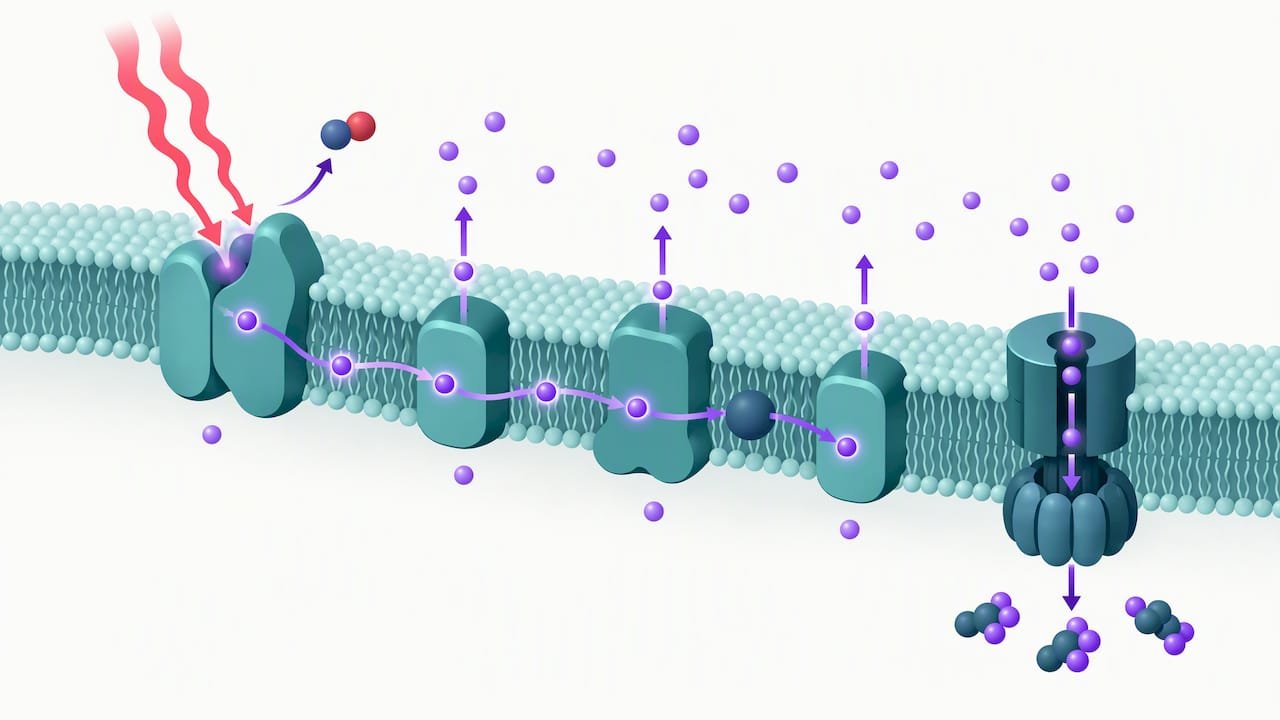
Once that inhibitory nitric oxide is released, electron flow through the chain picks back up. That shift raises the mitochondrial membrane potential, strengthens the proton gradient across the inner mitochondrial membrane, and gives ATP synthase more fuel to work with, so cells produce more usable energy.
The story does not stop at ATP, though. The same process generates a brief, controlled rise in reactive oxygen species (ROS), and rather than causing damage, this acts as a signal. This concept, called mitohormesis, triggers the cell to switch on protective genetic pathways, including Nrf2 and NF‑κB, which help cells defend against oxidative stress and inflammation.
Several points make this mechanism easier to picture:
- Photon absorption: red and near-infrared wavelengths penetrate tissue and are absorbed by CCO, the enzyme most sensitive to this light range.
- Nitric oxide release: light frees NO from CCO, restoring normal electron transport.
- Energy output: membrane potential and ATP synthesis rise as a result.
- Signalling cascade: a small ROS burst activates genes tied to cellular defence and repair.
One detail worth holding onto: tissue that is already under stress tends to respond more strongly. Mechanistic research suggests photobiomodulation works best where inhibitory nitric oxide concentrations are already elevated, which happens in compromised, inflamed or ageing cells. In healthy tissue, the inhibitory NO burden is lower to begin with, so the measurable boost is smaller. This context sensitivity explains why people managing chronic conditions or recovering from injury often notice more pronounced effects than someone with no underlying issue.
Human and lab studies that quantify ATP, metabolic and clinical outcomes
The mechanism only matters if it shows up in real outcomes, and a growing body of research backs that up with numbers.
One of the clearest human results comes from a glucose study. A 15-minute exposure to 670 nm light reduced the post-meal blood glucose rise by 27.7% during an oral glucose tolerance test, with the maximum glucose spike falling by around 7.5%. That is a meaningful signal that mitochondrial light exposure can influence metabolic handling of glucose, not just localised tissue repair.
A single 15-minute session of 670 nm light cut the post-meal glucose rise by 27.7% in a controlled human trial, giving one of the most concrete metabolic outcomes linked to mitochondrial light therapy to date.
Timing evidence comes largely from muscle cell research. In C2C12 myotube experiments, mitochondrial membrane potential and ATP production peaked between 3 and 6 hours after LED light exposure, rather than immediately. That delayed peak has real implications for how we schedule sessions around exercise or recovery, covered in the next section.
Zooming out, an umbrella review of randomised clinical trials covering photobiomodulation across the 600 to 1100 nm range found consistent support for increased ATP production, reduced oxidative stress, and clinical benefit in pain reduction and wound healing. The review also notes that NICE and MASCC guidelines endorse photobiomodulation for specific indications, such as preventing oral mucositis.
A few caveats are worth keeping in mind:
- Many of the strongest mechanistic studies are in cell cultures or animal models, not large human trials.
- Device types, wavelengths and dosing protocols vary considerably between studies, making direct comparisons difficult.
- Species differences mean results in mice or myotubes do not always translate exactly to human tissue.
None of this undermines the core finding, but it does mean we should treat red light therapy as a well-supported tool with a growing evidence base, not a guaranteed fix for every condition.
Which wavelengths and doses are used, and how do you calculate treatment time?
Not all red light is equal, and the wavelength matters as much as the fact that light is red at all. Research consistently points to two effective bands:
- Red light, roughly 630 to 670 nm: penetrates skin and superficial tissue effectively and is well studied for skin and surface-level applications.
- Near-infrared light, roughly 810 to 850 nm: penetrates deeper into muscle and joint tissue, making it useful for recovery and deeper structural targets.
- Broader photobiomodulation range, 600 to 1100 nm: the wider band referenced in umbrella review findings that captures the full spectrum of clinically useful wavelengths.
Dosing is where things get technical, but the concepts are simple once broken down. Irradiance, measured in milliwatts per square centimetre (mW/cm²), tells us how intense the light is at the skin’s surface. Total energy delivered, measured in joules per square centimetre (J/cm²), is irradiance multiplied by exposure time. A device delivering 50 mW/cm² for 300 seconds, for example, delivers 15 J/cm² of total energy.
This is where measuring irradiance to reach the right dose becomes genuinely important, because dose response is biphasic: too little energy produces no measurable benefit, while too much can blunt or reverse the effect. Time alone tells you nothing without knowing the irradiance behind it.
Pro Tip: Check your device’s irradiance specification before timing a session, since two devices with the same wattage can deliver very different doses depending on distance and beam spread.
When should you use red light for recovery or pre-exercise priming?
The 3 to 6 hour peak window observed in muscle cell studies changes how we think about scheduling sessions. If the goal is pre-exercise priming, a session completed several hours before activity, rather than immediately beforehand, may align better with peak ATP availability.
For general recovery, a single session still offers benefit, but repeated courses appear more relevant for supporting mitochondrial biogenesis, the process by which cells build new mitochondria over time.
A few practical scheduling patterns:
- Pre-event priming: a session completed 3 to 6 hours before competition or a demanding training block.
- Post-exercise recovery: a session shortly after activity to support tissue repair and reduce soreness.
- Ongoing courses: regular sessions across several weeks for those targeting longer-term mitochondrial adaptation rather than a one-off effect.
What outcomes does red light therapy plausibly improve?
Expectations matter, and the evidence base is stronger for some outcomes than others.
- Pain relief and soft tissue healing: supported by moderate-quality evidence from clinical trials and the umbrella review referenced above.
- Athletic recovery and performance: small trials suggest benefit, with some research pointing to improved time-to-exhaustion and altered oxygen uptake kinetics when light is applied before exercise.
- Skin repair and wound healing: multiple clinical reports support measurable improvement, with keratinocyte studies showing red light increases oxygen consumption and fat-burning activity within skin cells.
- Metabolic effects on blood glucose: promising early human data exists, but this remains an emerging application rather than routine clinical practice.
The common thread is that red light therapy tends to support the body’s own repair and energy processes rather than replacing them, which is why consistency and correct dosing matter more than a single dramatic session.
How do you use red light therapy safely?
Red light therapy operates in non-thermal ranges when used correctly, meaning it works through biological signalling rather than heat. NICE recognises specific clinical applications, including the prevention of oral mucositis, within defined treatment protocols.
A few safety points apply across most settings:
- Avoid direct, unprotected exposure to the eyes, particularly with higher-powered near-infrared devices.
- Follow the device manufacturer’s distance and timing instructions rather than guessing.
- Because of the biphasic dose response, more exposure is not automatically better and can reduce benefit.
- If you are pregnant, taking photosensitising medication, or undergoing active cancer treatment, raise red light therapy with your doctor or care team before starting.
Pro Tip: If a device does not list its irradiance or J/cm² output, treat that as a sign to look elsewhere, since you cannot dose what you cannot measure.
Live5D Health guidance on safe, measured red light sessions
At Live5D Health, we build our red light therapy sessions around the wavelength bands with the strongest evidence behind them.
- We work within the 630 to 660 nm and 830 to 850 nm bands, targeting both surface and deeper tissue.
- We dose sessions within the 4 to 30 J/cm² range commonly referenced in photobiomodulation research.
- Our eye safety findings from a five-minute exposure study inform the home-use rules we share with members.
- We measure irradiance directly rather than relying on wattage alone, so session times are set to match the dose your body actually receives.
How does red light therapy compare with hyperbaric oxygen and PEMF?
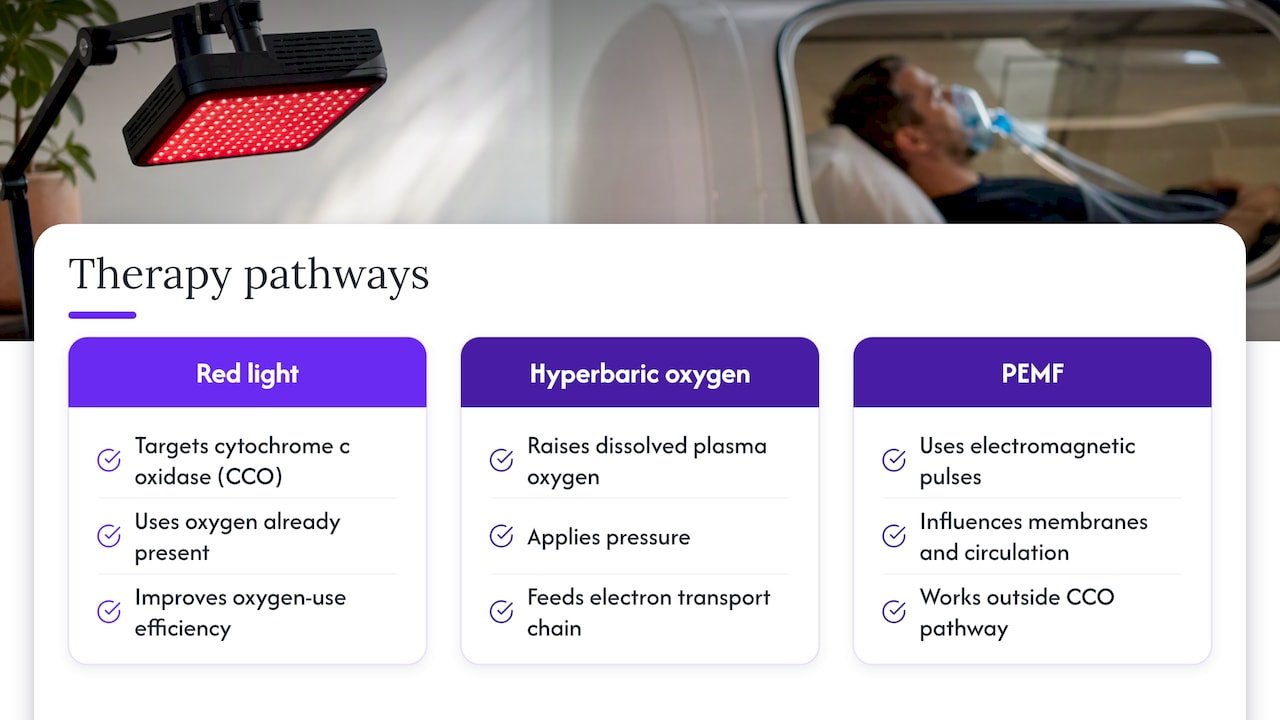
Red light therapy is one of several mitochondrial-targeted approaches we offer, and each works through a distinct pathway. Hyperbaric Oxygen Therapy increases the amount of oxygen dissolved in blood plasma under pressure, giving mitochondria more raw material for the electron transport chain to work with. Red light therapy, by contrast, acts directly on cytochrome c oxidase to improve how efficiently mitochondria use the oxygen already present.
PEMF (Pulsed Electromagnetic Field Therapy) takes a different route again, using electromagnetic pulses to influence cell membrane activity and circulation rather than working through the CCO pathway that red light targets. None of these therapies is a straightforward substitute for another, since they intervene at different points in cellular energy production.
For someone managing chronic fatigue or slow recovery, red light therapy tends to suit those wanting a short, measurement-led session with minimal preparation, while hyperbaric oxygen may suit those seeking a more intensive, oxygen-driven approach, and PEMF can appeal to those focused on circulation and tissue-level stimulation. Many members combine more than one, since the mechanisms do not compete with each other. Our team can talk through which combination fits your goals before you book.
How does red light therapy fit into a wider wellness routine?
Red light therapy rarely works best as an isolated treatment, which is part of why we built our centre around combining therapies rather than offering red light in isolation.
For general wellness maintenance, two to three sessions per week tends to support the mitochondrial adaptations described in the research above, while those targeting a specific recovery goal, such as post-injury healing, may benefit from more frequent sessions over a shorter course.
Pairing red light therapy with our sauna, steam and cold plunge spa supports circulation alongside the cellular signalling red light triggers. Members focused on recovery often combine sessions with our hyperbaric oxygen therapy, since both influence mitochondrial energy production through different routes. For those on a longer wellness journey, our 3, 5 and 10-day retreats build red light sessions into a broader schedule alongside massage, gym access and other therapies, giving the body multiple inputs rather than relying on one treatment to do everything.
The right frequency and combination depends on what you are working towards, and our staff can help map that out during a visit.
What are the common misconceptions about red light and mitochondria?
A few myths tend to follow red light therapy around, and clearing them up helps set realistic expectations.
The first is that more light always means more benefit. As covered above, dose response is biphasic, so pushing past the effective range can blunt results rather than improve them. Longer sessions are not inherently better.
The second myth is that any red-coloured light will do. Ordinary red bulbs or heat lamps do not deliver the specific wavelengths, typically in the 630 to 850 nm range, that interact meaningfully with cytochrome c oxidase. The biological effect depends on wavelength precision, not just colour.
A third misconception is that results are instant. Muscle studies show ATP and membrane potential peak 3 to 6 hours after exposure, so the biggest effects unfold over hours, not minutes.
Finally, some assume red light therapy works identically for everyone. Because the mechanism depends partly on existing nitric oxide levels within cells, response varies between healthy and compromised tissue, which explains why two people can use the same device and notice different results.
How do you choose a red light device for home use?
If you are looking to bring red light therapy into your own routine between clinic visits, a few things matter more than marketing claims. Look for a device that clearly states its wavelength, ideally within the 630 to 660 nm or 830 to 850 nm bands covered earlier, since vague claims about “red light” without a number are hard to evaluate. Irradiance output, in mW/cm², should also be listed so you can calculate realistic session times rather than guessing.
Our health and wellness store carries products selected with these same standards in mind, and our team can talk through which option suits your goals if you visit or get in touch. For anyone building a broader home wellness setup, pairing a red light device with structured water or magnesium support is something many of our members explore alongside their sessions, since cellular energy production and hydration support often go hand in hand. Readers researching the peptide signalling side of mitochondrial biology may also find the research on MOTS‑c retrograde signalling a useful deeper resource, though that falls outside what we offer directly.
Whatever you choose for home use, treat it as a complement to in-clinic sessions rather than a replacement, particularly if you are managing a specific condition.
Why individualised care still matters alongside the evidence
The mechanistic case for red light and mitochondria is genuinely strong, stronger than many wellness trends ever achieve. But the research also shows real variability between individuals, dose ranges, and conditions. We see our role as matching that evidence to the person in front of us rather than applying one protocol to everyone, and we always encourage a conversation with your own doctor for anything tied to an existing diagnosis.
— Mark
Book a measured red light therapy session with us
We offer red light therapy sessions built around measured irradiance rather than guesswork, so you know the dose you are receiving each visit.

- Sessions are priced per visit at the centre; current prices can be found on the pricing page.
- Session timing is set based on measured irradiance, following commonly referenced dosing ranges.
- Clients are asked to disclose any medical conditions, medication, or pregnancy before their first session.
Ready to feel the difference measured dosing makes? Book your red light therapy session with us today.
This article is general information, not a substitute for advice from a qualified doctor. Consult a qualified healthcare professional about your own circumstances before acting on anything here.
FAQ
How do LED lights impact mitochondria?
LED lights deliver red or near-infrared wavelengths that are absorbed by cytochrome c oxidase in mitochondria, which can increase ATP production and trigger protective cellular signalling. The effect depends on the LED’s specific wavelength and output, not simply on the light appearing red to the eye.
Can red light therapy increase energy?
Yes, red light therapy can support cellular energy by improving mitochondrial ATP production, with muscle cell studies showing this effect peaks 3 to 6 hours after exposure. Many people also report a subjective sense of improved energy, though that experience varies between individuals.
Can red light therapy reduce scar tissue?
Red light therapy is linked to improved tissue repair and wound healing outcomes, supported by findings in an umbrella review of clinical trials. While this supports a role in soft tissue recovery, results for established scar tissue specifically will depend on the type and age of the scar, so discussing your case with a clinician is worthwhile.
When should you check with a doctor before trying red light therapy?
It is worth checking with a doctor before starting red light therapy if you are pregnant, taking photosensitising medication, or undergoing active cancer treatment. Anyone with an existing eye condition should also ask about eye safety precautions before a session, particularly with near-infrared devices.
Sources
- Red light can reduce blood glucose levels — UCL news
- Low‐level laser (light) therapy increases mitochondrial membrane potential and ATP synthesis in C2C12 myotubes with a peak response at 3–6 h
- Effects of photobiomodulation on multiple health outcomes: an umbrella review of randomized clinical trials