
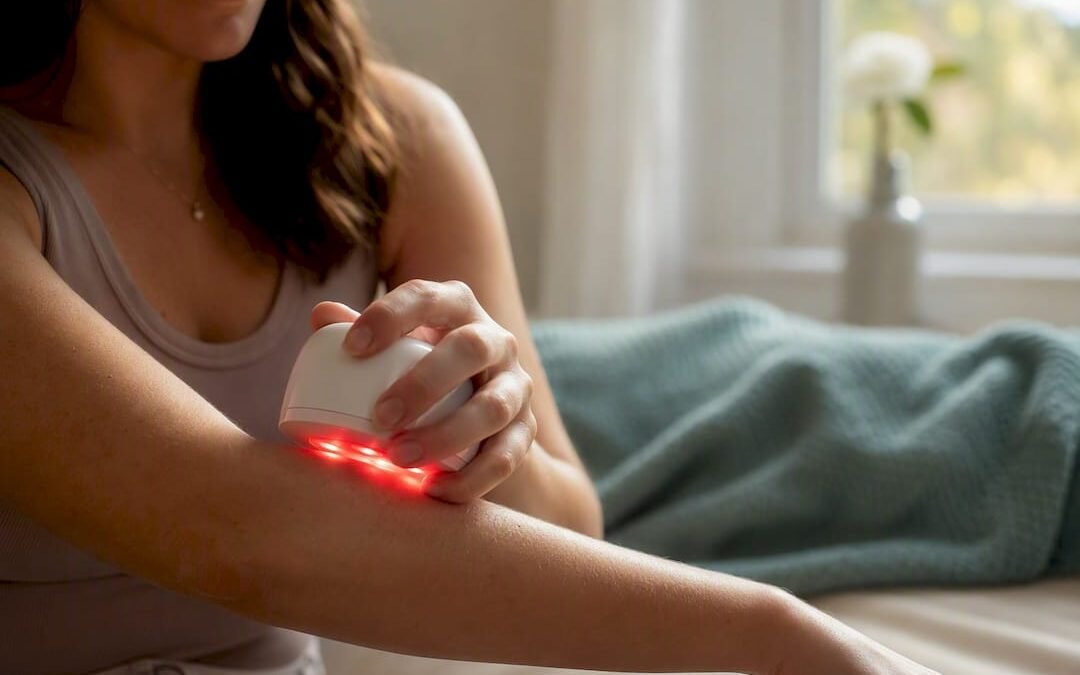
Red light therapy is generally low risk when used correctly, but misuse can cause burns, blisters or eye injury. The American Medical Association confirms it carries no known cancer risk, because it doesn’t use ultraviolet radiation at all. That single fact separates red light therapy from sunbeds and most tanning devices, and it’s the reason dermatologists treat it so differently.
Most people who try it experience nothing more dramatic than:
- Mild redness or warmth in the treated area
- Temporary tingling or a light stinging sensation
- Brief dryness that settles within hours
Before your first session, remember three things: never shine a device directly into your eyes, follow the manufacturer’s distance and timing guidance to the letter, and speak to your GP first if you’re pregnant or taking photosensitising medication. Get those right, and you’ve addressed the vast majority of documented risk.
Quick fact: the AMA notes that side effects are typically mild and short-lived, limited to temporary redness, pain, or irritation rather than anything more serious.
Key Takeaways
Red light therapy carries a genuinely low short-term risk profile, but nearly every serious side effect traces back to overexposure, poor device calibration, or skipping basic precautions like eyewear and patch testing.
| Point | Details |
|---|---|
| No cancer link | Red light therapy uses no UV radiation, so it isn’t associated with skin cancer risk. |
| Mild reactions are normal | Expect brief redness, warmth or dryness that clears within hours to a day. |
| Serious harm is avoidable | Burns, blistering and eye injury almost always stem from misuse, not the therapy itself. |
| Check contraindications first | Pregnancy, photosensitising medication, active cancer lesions and implants all warrant medical advice beforehand. |
| Supervised sessions reduce risk | Clinics like Live5dhealth offer calibrated dosing and trained oversight that home devices often lack. |
Table of Contents
- Common, mild side effects: what to expect and how long they last
- Can red light therapy cause serious harm like burns or eye damage?
- Who should avoid red light therapy or take extra precautions?
- At-home devices versus clinical treatment: does the setting change the risk?
- How do you use red light therapy safely at home?
- Aftercare: what’s normal, and when should you call a doctor?
- What does the current evidence actually show?
- Why safety, not hype, should drive your decision
- Ready to try red light therapy under expert supervision?
- Sources
Common, mild side effects: what to expect and how long they last
Your skin’s first response to red light exposure usually shows up within minutes and fades within a short period. This is your body’s normal reaction to increased blood flow and cellular activity, not a sign that something has gone wrong.
The typical reaction pattern includes redness appearing during or immediately after treatment, mild warmth on the skin’s surface, mild stinging or tightness especially on sensitive skin, and dryness or light flaking with frequent sessions.
Severity matters here. A pink flush that fades by bedtime is normal. Persistent redness lasting several days, swelling, or blistering is not, and it signals you’ve overdone the dose or session length. The American Academy of Dermatology points out that people with darker skin tones face a higher risk of hyperpigmentation from repeated light exposure, so what counts as a “normal” reaction can vary noticeably from one skin type to another.
Pro Tip: Treat your first session like a patch test. Use a shorter exposure time and a lower intensity setting than the manufacturer’s standard recommendation, then wait 24 hours before your next session to see how your skin actually responds.
This matters more than people expect. Skin tolerance to light exposure isn’t static. It shifts with medication, sun exposure earlier that week, hydration levels, and even the products you’ve applied recently. A five-minute test session tells you far more than reading the box.
Can red light therapy cause serious harm like burns or eye damage?
Yes, but almost always through misuse rather than the therapy itself. Serious adverse effects are uncommon when devices are used within tested parameters, yet case reports and controlled studies confirm they do happen.
Research on LED red light exposure has documented occasional prolonged erythema and hyperpigmentation at maximum tolerated doses, with no serious systemic harm observed in the short term.
Clinical trials examining light emitting diode red light on human skin found that even at the upper end of tested exposure, adverse events remained mostly limited to skin reactions rather than deeper injury — but “mostly limited” still means some participants experienced blistering and extended redness that took longer than expected to resolve.
Eye injury is the risk people underestimate most. High-intensity LED and laser-based devices emit concentrated light that can damage the retina with direct or prolonged exposure, which is why protective eyewear is recommended for many higher-powered panels, particularly in professional settings.
Thermal burns follow a predictable pattern: someone places a device too close to the skin, leaves it on for far longer than instructed, or uses a high-power clinical-grade panel at home without understanding its actual output. Harvard Health notes that misuse of at-home devices is a leading cause of these adverse events, tying burns and blistering directly back to irradiance levels exceeding standard guidance.
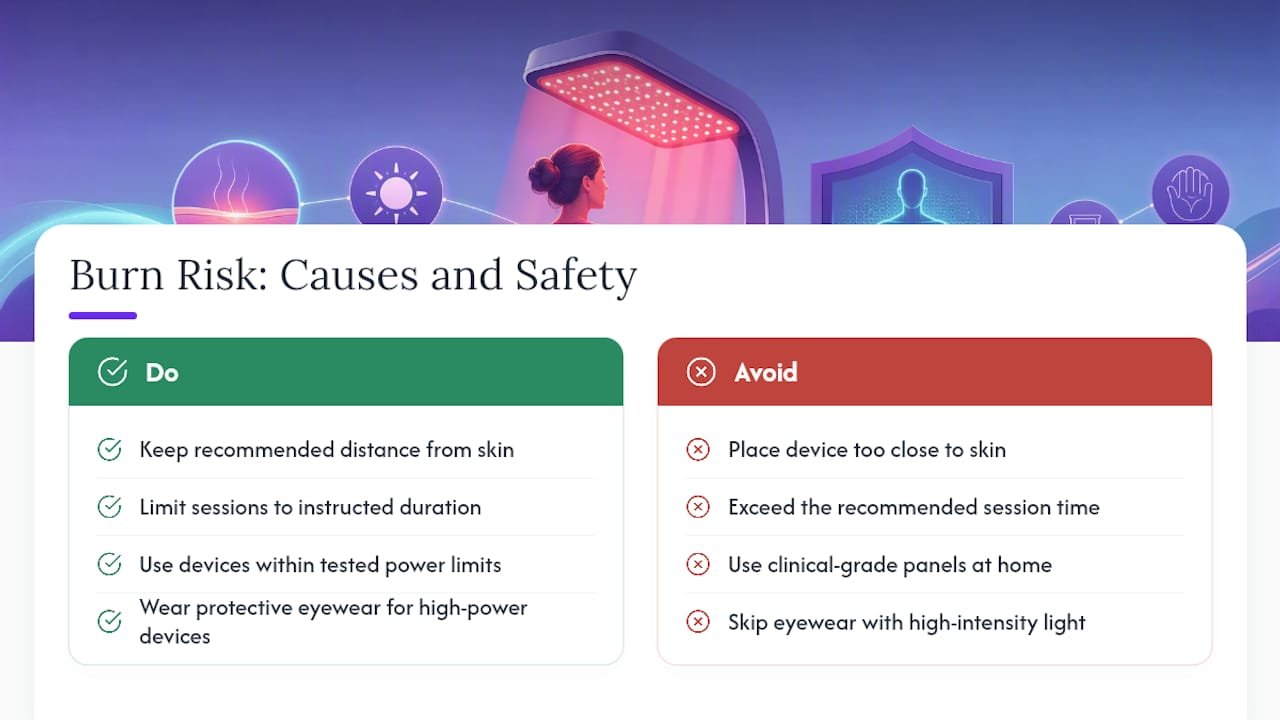
The reassuring part: nearly every serious event traces back to a dosing error, not a flaw in the therapy itself. Correct distance, correct duration, and correct supervision remove almost all of this risk.
Who should avoid red light therapy or take extra precautions?
Certain people need a conversation with a clinician before they start, not after something goes wrong. Red light therapy isn’t universally risk-free, and pretending otherwise does readers a disservice.
- Anyone on photosensitising medication or supplements. Certain antibiotics, retinoids, and some herbal supplements increase skin sensitivity to light. Check with a pharmacist or prescriber before adding light exposure to your routine.
- Pregnant or breastfeeding women. Evidence here is limited rather than alarming, but limited evidence still means limited evidence. A quick chat with your GP or midwife costs nothing and closes that gap.
- People with active cancer lesions or recent radiotherapy. Skin in these areas needs specialist clearance before any additional light-based treatment, given how sensitive irradiated or lesion-affected tissue can be.
- Anyone with implants near the treatment site, particularly if the implant’s manufacturer flags heat or light sensitivity in its own guidance.
- People with photosensitive conditions or epilepsy, especially around pulsed or flashing red light devices, which can pose a seizure risk for a small subset of users.
- Anyone with very reactive or highly sensitive skin. Start low, go slow, and don’t assume your skin behaves like the reviews you read online.
If you fall into any of these categories, Live5dhealth’s guidance on who should avoid red light therapy walks through the reasoning in more depth, and a proper consultation beats guesswork every time.
At-home devices versus clinical treatment: does the setting change the risk?
It does, substantially. The gap between a supervised clinic session and an unboxed home device isn’t just about comfort. It’s about dosing control.
Clinic-based devices tend to offer:
- Calibrated, consistent output that’s been tested and maintained
- A trained operator adjusting distance, duration and intensity to your skin type
- Stronger panels used for shorter, carefully timed sessions
At-home devices, by contrast, show enormous variation in actual irradiance output, and labelling is often inconsistent or missing altogether. That gap between the box and the beam is exactly where most consumer misuse originates.
Here’s where confusion sets in for a lot of buyers: FDA clearance or a CE mark on a device. Both of these relate to safety classification, confirming a device meets a low-risk threshold, not that it’s clinically proven effective for the specific concern being marketed. A cleared device and an effective device aren’t automatically the same thing.
Before buying a home unit, check for:
- Published irradiance figures in mW/cm², not just wavelength
- Built-in safety cut-offs or timers
- Documented clinical evidence behind the specific model, not just the general therapy
If you’d rather skip that evaluation entirely, a supervised session at a dedicated wellness clinic removes the guesswork, because the calibration and dosing decisions are already handled for you.
How do you use red light therapy safely at home?
Following a consistent routine cuts your risk dramatically, and none of these steps require special equipment or expertise.
- Patch test first. Run a short, low-intensity session and wait 24 hours before repeating it.
- Stick to manufacturer or clinical protocols for distance, duration and frequency rather than improvising based on how good it feels.
- Wear protective eyewear when recommended, and never stare directly into a high-intensity panel, even briefly.
- Avoid topical photosensitisers like certain retinoid-based facial serums around session times, since they can amplify skin reactions.
- Keep a simple session log noting duration, distance and how your skin reacted, then check your skin daily for anything unusual.
- Stop immediately if you notice persistent redness, blistering, pain, or any change in your vision.
Pro Tip: Photograph the treated area once a week using the same lighting and angle. Subtle changes in pigmentation are far easier to spot in photos than in the mirror, where you see your own skin every day and miss gradual shifts.
This isn’t about being overly cautious. It’s about giving yourself the information to catch a problem in its first week rather than its third.
Aftercare: what’s normal, and when should you call a doctor?
Most reactions need nothing more than basic aftercare. A cool compress, a gentle fragrance-free moisturiser, and staying out of direct sun exposure for the rest of the day usually settles any mild redness or tightness.
Skip active ingredients like retinol, vitamin C serums, or exfoliating acids on treated skin for at least 24 hours afterwards. Layering actives on top of a light-stimulated area is asking for irritation you didn’t need.
Watch for the difference between expected and concerning:
- Normal: redness fading within hours to a day, mild warmth, slight dryness
- Reasons to contact your GP or dermatologist: blistering, spreading rash, severe or worsening pain, swelling that doesn’t subside, or any change in vision
If you’re using red light therapy as part of managing an existing condition, keep your treating clinician updated on your progress. Stop sessions and seek advice if the underlying condition worsens rather than improves, since that’s a clear sign the treatment isn’t suiting your particular case.
What does the current evidence actually show?
Short-term studies are reassuring. Longer-term data is still catching up, and that honesty matters more than false confidence.
Trials examining LED red light exposure on human skin report that adverse events remain generally mild even at maximum tolerated doses, with no serious systemic harms recorded in short-term follow-up. That’s a solid foundation, but it’s not the same as multi-year safety data, which simply doesn’t exist yet in large enough studies to draw firm conclusions.
Stanford Medicine researchers frame red light therapy as a complementary treatment rather than a standalone cure, recommending dermatologist input whenever someone is using it to address a genuine medical concern rather than general wellness maintenance.
At Live5dhealth, that’s exactly how we frame it for clients too. Red light therapy sits within a broader wellness picture, alongside supervised sessions and professional consultation, not as a solo fix for conditions that need a proper diagnosis first. If something isn’t improving after several supervised sessions, that’s the signal to pause and reassess rather than push through.
Why safety, not hype, should drive your decision
Most of what gets written about red light therapy either oversells it as a miracle fix or underplays the handful of genuine risks worth knowing. Neither approach helps you make a decent decision.
The conventional advice tends to stop at “it’s generally safe,” which is true but incomplete. It rarely explains that risk concentrates almost entirely in two places: unsupervised high-intensity exposure and skipping basic precautions like eyewear or patch testing. Fix those two things and you’ve eliminated most of what could go wrong.
What’s underrated is how much skin type changes the calculation. Guidance aimed at a general audience often glosses over the fact that darker skin tones need a more cautious starting dose and closer monitoring for hyperpigmentation. That’s not a minor footnote. It should shape how anyone with melanin-rich skin approaches their first few sessions.
If you take one thing from this, prioritise dosing control over device power. A well-calibrated, moderate-intensity session under proper guidance beats an aggressive, unsupervised one every time.
— Mark
Ready to try red light therapy under expert supervision?
Reading about correct dosing is one thing. Getting it right on your own, with a device whose actual irradiance output you can’t verify, is another. That’s the real gap between what you’ve just learned and what happens once you’re standing in front of a panel deciding how close to stand.
At Live5dhealth, our red light therapy sessions are delivered by trained practitioners who calibrate intensity and duration to your skin and your goals, so you get the benefits without guessing at safe exposure limits. That’s the practical advantage over a home device you’ve researched for an afternoon: someone who does this daily is adjusting the variables for you, not leaving you to interpret a manual. We also work alongside complementary therapies, including structured wellness retreats and targeted supplement support from our online shop, so your skin and recovery goals are supported from more than one angle. If you’re ready to experience red light therapy properly calibrated and supervised, book a session at our Boyle wellness centre and see how it fits into your broader health routine.
This article is general information, not a substitute for advice from a qualified doctor. Consult a qualified healthcare professional about your own circumstances before acting on anything here.
Sources
- 6 things patients should know about red light therapy | American Medical Association
- Red light therapy for skin care – Harvard Health
- Red light therapy: What the science says | Stanford Medicine
- Is red light therapy right for your skin? | American Academy of Dermatology
- Safety of light emitting diode-red light on human skin – PMC