
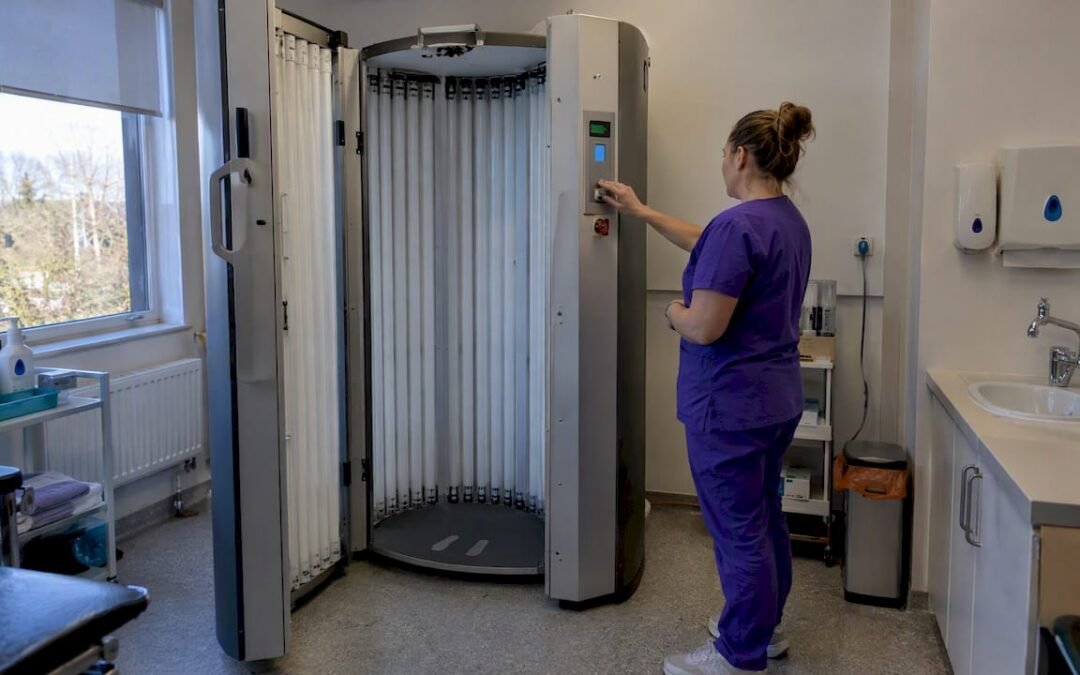
Commercial sunbeds are not an endorsed treatment for eczema, and we would never suggest one as a substitute for medical care. Sunbeds emit an uncontrolled mix of UVA and some UVB with no dose calibration, while clinical phototherapy uses narrowband UVB under close medical supervision. If you are weighing up light-based options for your skin, we offer a supervised assessment before anything else, with guidance on photobiomodulation benefits and dosage to inform your decision.
TL;DR:
- Commercial sunbeds emit mostly UVA with inconsistent UVB, while clinical phototherapy calibrates narrowband UVB or UVA1 to skin type and adjusts doses under medical supervision.
- Indoor tanning can more than double melanoma risk, while burns, irritation, eye damage, and infection risks are especially concerning on broken or inflamed eczema skin.
- People under 18, those with fair skin or sensitivity to sunlight, anyone taking photosensitizing medication, and people whose eczema flares in sunlight should avoid sunbeds.
- Anyone who proceeds should disclose eczema and medications, wear goggles, avoid damaged skin, and stop if irritation begins; these steps do not make sunbeds safe.
Table of Contents
- What sunbeds are and how they differ from clinical phototherapy
- What the evidence says about sunbeds and eczema
- Health risks and who should avoid sunbeds
- If you still consider a sunbed: harm-minimising practical steps
- Live 5D Health guidance and clinic-grade options
- Our view on light therapy and eczema
- How we can help: supervised assessment and bookings
- FAQ
- Sources
What sunbeds are and how they differ from clinical phototherapy
A commercial sunbed is built for cosmetic tanning, not skin treatment. Most units emit predominantly UVA, with a smaller and inconsistent dose of UVB, and output varies widely from one machine to the next because tanning equipment is not standardised the way medical devices are, according to a photodermatology handbook. You step into a sunbed with little idea of the exact spectrum or intensity you are receiving.
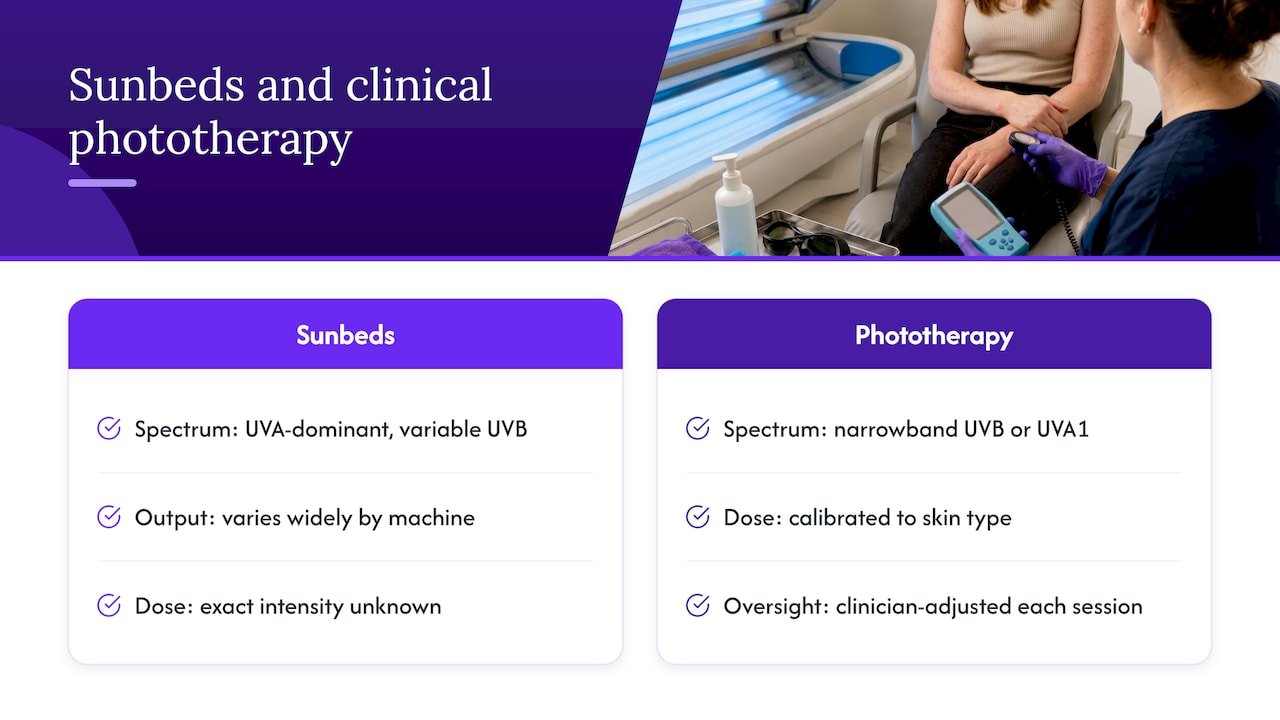
Clinical phototherapy works differently. Dermatology units deliver narrowband UVB or UVA1 at a calibrated dose, calculated for the patient’s skin type and adjusted session by session under a clinician’s direction, as Healio’s clinical guidance sets out. That dose control matters because ultraviolet light interacts with the immune cells in your skin, and the effect depends heavily on wavelength and dose. Get it right and you can calm an overactive immune response. Get it wrong, through an uncontrolled sunbed, and you risk burning already compromised skin or disrupting the barrier function eczema already weakens.
What the evidence says about sunbeds and eczema
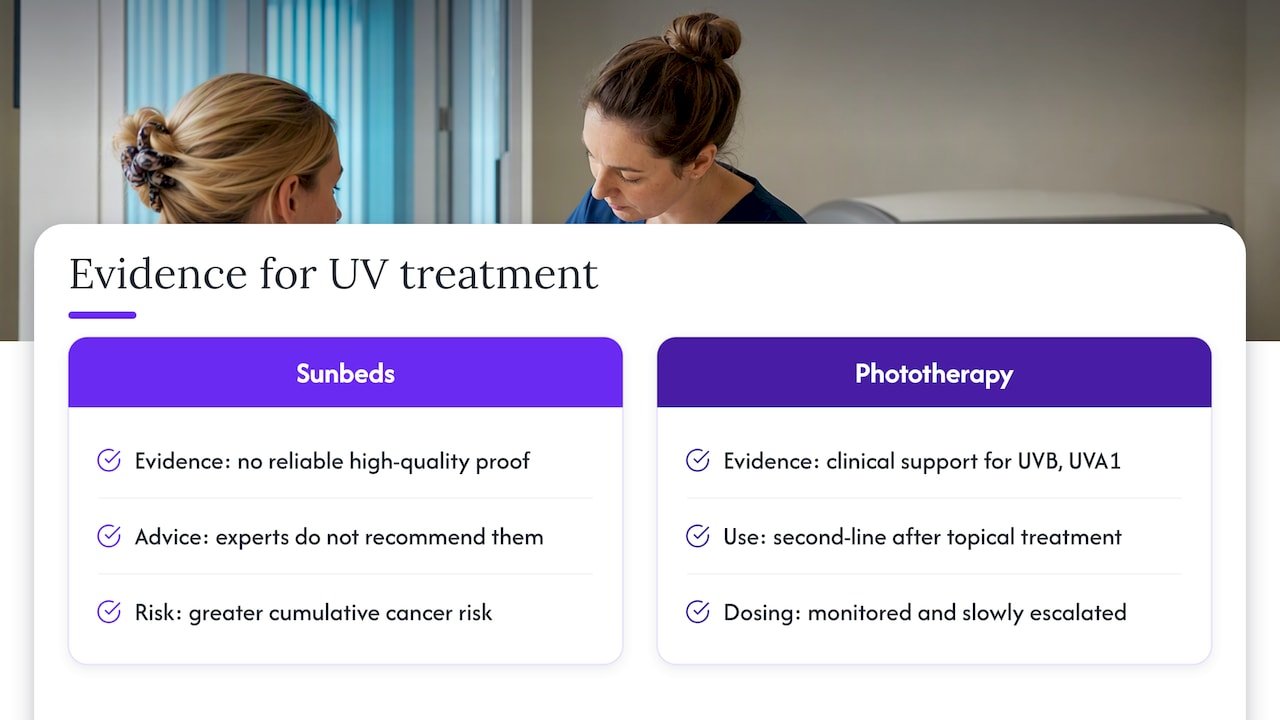
There is no reliable, high-quality evidence that commercial sunbeds are a safe or effective way to treat eczema. A peer-reviewed review of tanning beds as a dermatological treatment found that medical experts do not recommend sunbeds for this purpose, precisely because they deliver uncontrolled, high-intensity UVA and UVB without the oversight that makes clinical phototherapy workable. The review also noted that because tanning beds are UVA-dominant and poorly standardised, any perceived skin benefit is likely inconsistent and comes with greater cumulative cancer risk than dose-calibrated clinical treatment.
That contrast matters. The clinical evidence base for narrowband UVB and UVA1 in moderate to severe atopic dermatitis is built on monitored, slowly escalated dosing, which is part of why it works as a second-line option when topical treatment has not been enough, per the same Healio guidance. Nothing comparable exists for commercial sunbeds, where the spectral output and strength can differ from one salon to the next, as Medical News Today reports.
The biology helps explain why responses to UV are so unpredictable. Ultraviolet exposure can modulate the immune activity that drives eczema flares, which is why some people notice short-term improvement after sun exposure, but the same exposure can damage the skin barrier that eczema already compromises, with the balance shifting by dose and wavelength, according to a review on UV radiation and atopic dermatitis. Anecdotal relief from a day at the beach does not translate into a sunbed being a safe or validated medical treatment, and dermatologists generally advise against using one for that purpose.
Health risks and who should avoid sunbeds
Beyond the lack of evidence for eczema specifically, sunbeds carry risks that apply to anyone using them. The American Academy of Dermatology notes that indoor tanning can more than double the risk of melanoma and raises the risk of squamous cell and basal cell carcinoma too. National guidance reinforces the same caution for recreational use.
- Acute harms include burns, dry or itchy skin, and eye damage if protective goggles are skipped.
- Broken or actively inflamed eczema skin faces a higher infection risk on shared tanning equipment, and the heat and UV intensity can aggravate the lesion further, as Medical News Today points out.
- People under 18, those with fair or sun-sensitive skin, anyone on photosensitising medication, and people whose eczema flares with sun exposure should avoid sunbeds altogether, following HSE guidance on UV tanning equipment.
NHS Inform’s sunbed and tanning safety guidance is consistent with this: sunbeds typically emit a higher proportion of UVA than natural sunlight and should not be used for non-medical tanning, while supervised phototherapy remains the appropriate route for certain skin conditions.
If you still consider a sunbed: harm-minimising practical steps
If you decide to use a commercial sunbed despite this guidance, a few precautions reduce the harm, though they do not make the practice safe or appropriate for eczema.
- Keep sessions short and infrequent, and never let your skin reach the point of burning.
- Tell staff about your eczema and any current treatments before you start, since some topical and oral medicines increase photosensitivity, including psoralens.
- Wear the eye protection provided every time, and avoid treating any area with broken, weeping or heavily inflamed skin.
- Moisturise generously before and after sessions, book regular skin checks, and stop immediately if you notice irritation, stinging or a flare.
Pro Tip: If your skin reacts within the first minute of a session, that is your cue to stop, not to push through for the perceived benefit.
Live 5D Health guidance and clinic-grade options
We take a cautious, clinic-first view of ultraviolet exposure, which is why our UV light therapy risk guidance sets out the safety considerations we ask every client to think through before booking a session. Supervised medical phototherapy for eczema is a different intervention entirely from recreational sunbed use, and it should always be directed by a clinician who can calibrate the dose to your skin type and condition.
We approach all of our light-based therapies with the same discipline we apply when we measure irradiance for red light dosing and when we tested eye safety protocols for red light sessions. That same rigour shapes how we assess suitability for UV light therapy, talk through alternatives, and help you understand whether a supervised session fits your skin and your health history.
Our view on light therapy and eczema
We think the gap between a quick tan and a genuine treatment plan is too often glossed over, and eczema sits right in that gap. Every case behaves differently: what calms one person’s skin can flare another’s, which is exactly why a blanket recommendation for or against UV exposure misses the point. Our stance is simple. Talk to a professional before you let light near inflamed skin, and treat a clinic assessment as the first step, not the last resort.
— Mark
How we can help: supervised assessment and bookings
If you are weighing up light-based options for your skin, we offer a proper consultation before anything else, so you understand what a session involves and whether it suits your skin type. Our sunbed UV light therapy service sits within a facility built around safety protocols and supervised sessions, not guesswork.
If you would rather explore alternatives first, our team can talk you through options like red light therapy during the same visit. To arrange a consultation or book a session, visit our booking page and we will take it from there.
This article is general information, not a substitute for advice from a qualified doctor. Consult a qualified healthcare professional about your own circumstances before acting on anything here.
FAQ
Is UV light good for eczema?
UV light can calm the immune activity behind some eczema flares, but the effect depends on dose, wavelength and supervision. Clinical phototherapy is used for some patients under medical direction, while unsupervised exposure from a commercial sunbed is not recommended by dermatologists, per Medical News Today.
What is the difference between UVB therapy and sunlight?
Clinical narrowband UVB delivers a specific, calibrated wavelength at a controlled dose under medical supervision, while natural sunlight contains a broader, variable mix of UVA and UVB that changes with time of day and season. Commercial sunbeds are closer to uncontrolled sunlight exposure than to clinical UVB, since their output is poorly standardised, according to a photodermatology handbook.
Can a sunbed make eczema worse?
Yes, a sunbed can worsen eczema by burning already sensitive skin or disrupting the skin barrier that eczema weakens. Anyone with active, broken or heavily inflamed lesions faces a higher risk of irritation and infection from sunbed sessions, as Medical News Today notes.
Who should avoid using a sunbed altogether?
People under 18, those with fair or sun-sensitive skin, anyone taking photosensitising medication, and people whose eczema flares with sun exposure should avoid sunbeds, based on HSE guidance. These groups face a disproportionately higher risk of burns, skin damage or flare-ups.
Does Live 5D Health offer medical phototherapy for eczema?
We offer UV light therapy as a supervised wellness service, and our team can talk through suitability and safety before any session, as described on our sunbed UV light therapy page. A diagnosis or prescription for medical phototherapy would come from a dermatologist rather than a wellness setting.
Sources
- A review of the use of tanning beds as a dermatological treatment (PMC)
- HSE guidance on UV tanning equipment (MISC869)
- Medical News Today — indoor tanning and eczema