
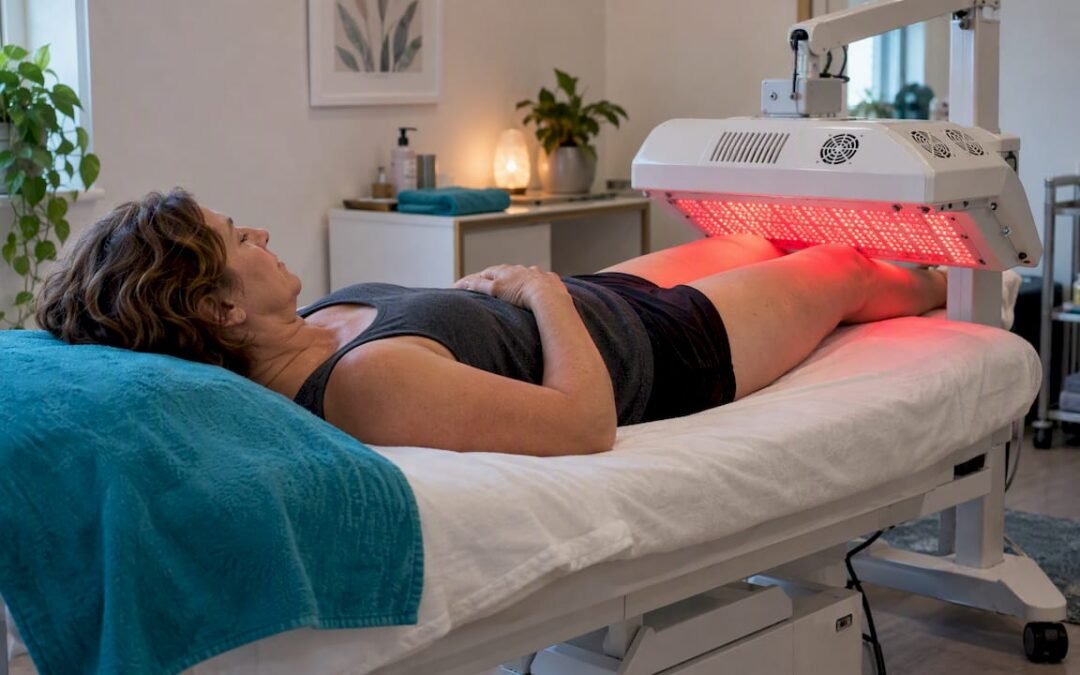
Red light therapy will not erase cellulite on its own. The best trials suggest it works as a supporting treatment: it can improve skin comfort and, when combined with a topical anti-cellulite product, it has been linked to a lower cellulite grade. If you want an honest picture of what to expect before you book, this guide gives you the research, a realistic session plan and the safety points to check.
We offer red light therapy at our wellness centre in Boyle, County Roscommon. We would rather you arrive with realistic expectations than with a promise that no light panel can keep.
TL;DR
- Red light is a supportive tool for cellulite, not a stand-alone fix. Major health bodies such as the Cleveland Clinic say there is no scientific evidence for it as a stand-alone cellulite treatment.
- The strongest result in our research came from light combined with a topical gel over three months. The light bed alone showed no change from baseline.
- More power is not better. Light therapy has a biphasic dose response, so steady, moderate sessions beat “maxing out”.
- Skin type, hygiene and any medical condition (including cancer) matter. Talk to your GP or oncologist first if either applies.
- Our published price for a red light session is €20 to €40, and you can book red light therapy here.
Table of Contents
- What cellulite is, and why light is even in the conversation
- What the trials actually found
- Red light body contouring: what “contouring” can and cannot mean
- What a realistic plan looks like
- Safety: more is not better
- If you have cancer or are in treatment
- Our perspective: where red light fits
- Pairing red light with other therapies
- Book a red light session in Boyle
- How to judge any red light provider
- FAQ
- Sources
What cellulite is, and why light is even in the conversation
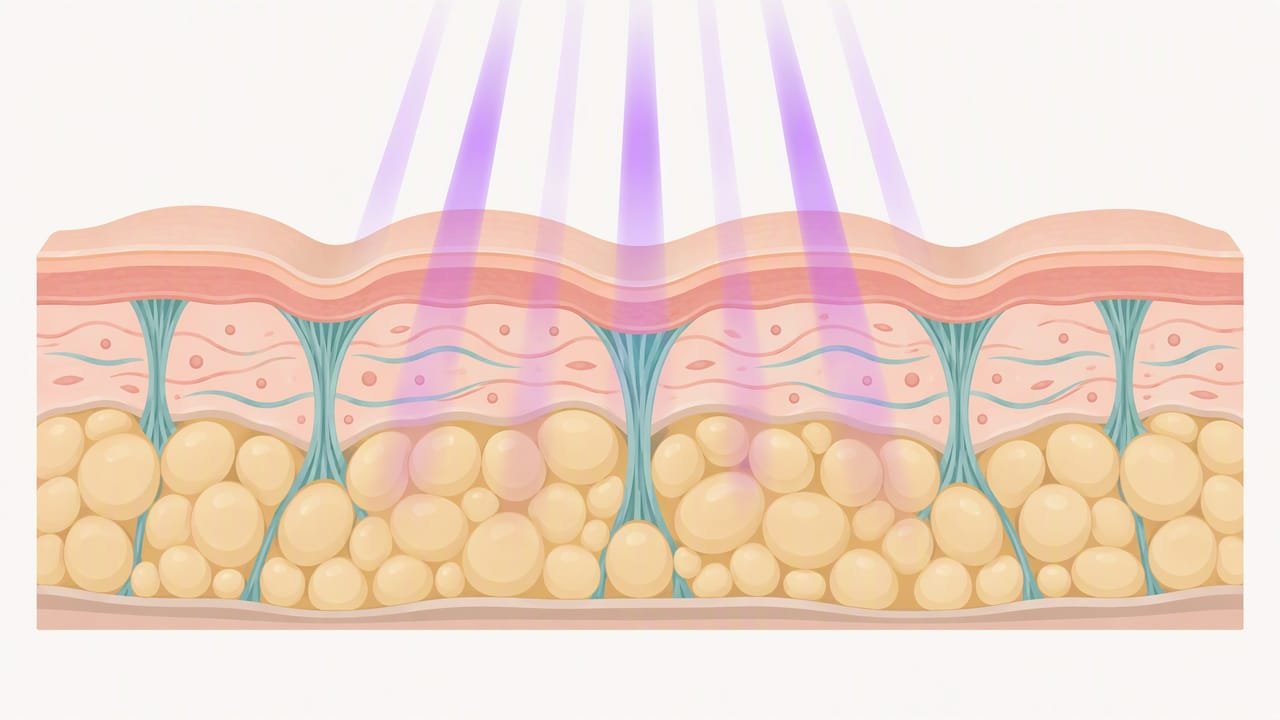
Cellulite is the dimpled, uneven texture that appears most often on the thighs and buttocks. It is extremely common in women, and it is not a disease. It reflects how fat, connective tissue and the skin’s structure sit together. Because it involves the skin’s collagen network, blood flow and low-grade inflammation, researchers have tested light-based treatments on it.
Red light therapy, also called photobiomodulation, uses low-level red and near-infrared light, usually from LEDs. It is thought to act on the mitochondria, the “powerhouse of the cell”, and on inflammation and circulation. If you want the cellular side explained, read our piece on red light and mitochondria.
The key point is that cellulite is mostly a structural issue. Light can influence the tissue around that structure, but it does not cut or remove it. That is why results in studies are modest and why combination approaches do better.
What the trials actually found
Search results will tell you red light “melts” cellulite. The clinical literature is more careful. Here are the three pieces of research we consider most useful.
Light plus a topical gel: the clearest improvement
A 2023 randomised trial tested an LED bed together with a topical anti-cellulite gel applied twice daily. Sessions lasted 20 minutes, twice a week, for 3 months. The combined group’s cellulite moved to a lower severity grade, and skin elasticity increased. The group using the LED bed alone showed no change from baseline, and its elasticity decreased.
That is an important lesson. Light seems to help most when something else addresses the skin and the tissue just beneath it.
Light and comfort: pain threshold and inflammation
A 2024 randomised, placebo-controlled trial in 25 women with grade 2 to 4 cellulite used 650 nm LED light three times a week for four weeks. The pain threshold in treated areas rose by 8% to 20%, and skin temperature dropped slightly. The researchers read this as a sign that light may ease the inflammatory symptoms of cellulite, such as tenderness. The group that also received systemic light (LED plus ILIB) saw a 32% increase in pain threshold.
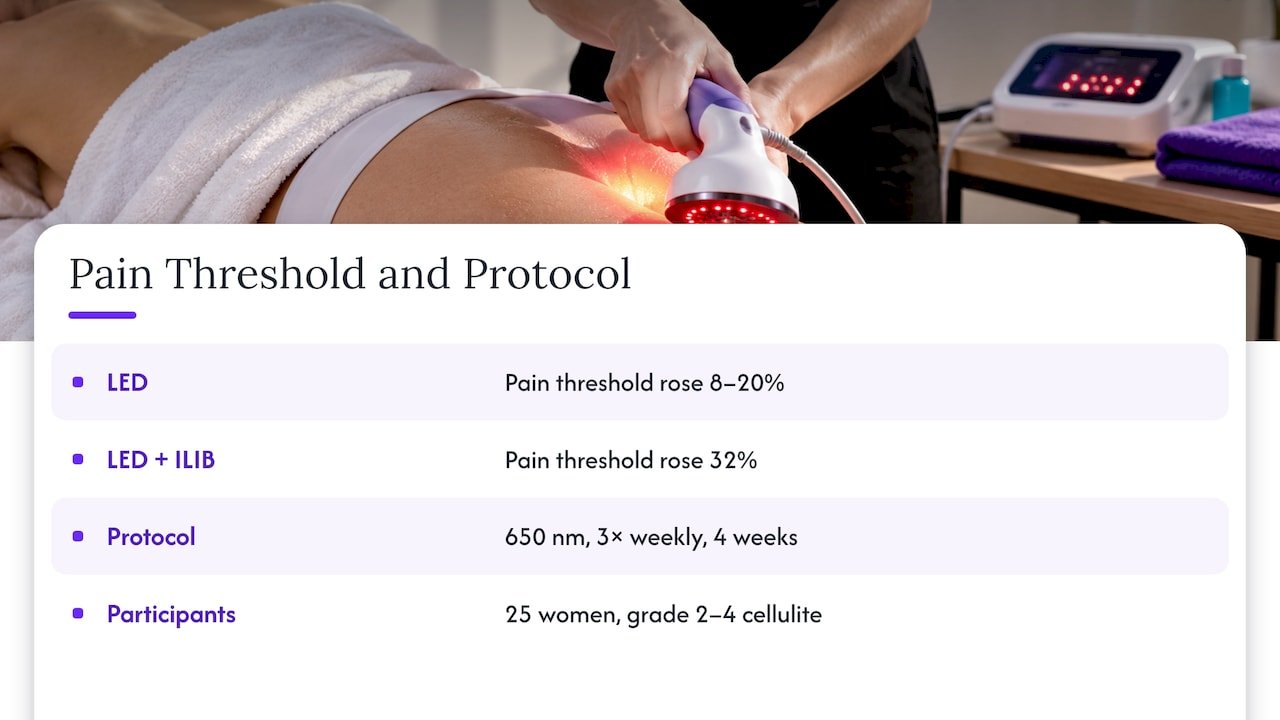
Note what was measured: comfort and inflammation markers, not a dramatic change in dimples.
The sober view from major health bodies
The Cleveland Clinic states there is no scientific evidence to support red light therapy as a stand-alone treatment for weight loss or cellulite removal. It adds that any change in body contour may be temporary and linked to fluid shifts, not lasting fat loss.
If you see a before-and-after photo online, ask what else the person was doing and how long the result lasted.
Red light body contouring: what “contouring” can and cannot mean
Many people search for body contouring when they are really asking whether light can reduce fat. Some small studies look at LED photobiomodulation for abdominal fat, but the current picture does not support calling it a fat-loss treatment. A temporary slimmer look after a session can come from fluid moving, not from fat cells shrinking permanently.
So be wary of any provider who promises centimetres lost. A fair way to describe it is that red light may support skin quality and comfort as part of a wider routine of strength training, nutrition and circulation work.
What a realistic plan looks like
There is no universal protocol. Study schedules vary, and the figures below show what has been tested, not a guarantee.
| Element | What the research used | What it means for you |
|---|---|---|
| Frequency | 2 to 3 sessions a week | Consistency matters more than intensity |
| Duration of programme | 4 weeks to 3 months | Judge results after at least 8 to 12 weeks |
| Session length | 20 minutes in the 2023 trial | Shorter or longer is not automatically better |
| Add-ons | Topical anti-cellulite gel twice daily | Light alone showed no change in that trial |
A sensible way to approach it
- Photograph your starting point in the same light, from the same angle, so you can judge honestly.
- Commit to a block of 8 to 12 weeks rather than a couple of visits.
- Pair it with movement. Strength work for glutes and legs improves muscle tone beneath the skin. Our gym is part of the same centre.
- Add a skin-focused routine, such as a topical product your pharmacist or dermatologist is happy with.
- Review at the end. If you see no change in comfort, texture or elasticity, it is fair to stop.
Safety: more is not better
Light therapy follows what researchers call a biphasic dose response. A randomised safety study of high-fluence LED red light found that very high doses, often above 480 J/cm², can cause blistering or prolonged redness instead of benefit. A good provider uses moderate, consistent doses.
Skin type matters too. 2026 findings indicate darker skin can be more photosensitive to higher fluences of LED red light, so settings and duration should suit your skin type to avoid redness or temporary hyperpigmentation. Tell your practitioner your skin type and any history of reactions before you start.
For the full list of what to look out for, see our guide to red light therapy side effects. If you will have light near your face, our eye safety guide covers protective habits.
Wavelength and quality of device
Not every panel delivers what its box claims. Wellness-grade red light typically sits in the red (about 630 to 660 nm) and near-infrared (about 830 to 850 nm) ranges. We explain this in red light wavelengths that work.
Hygiene in shared spaces
Any shared equipment, from headrests to massage tools, should be cleaned between clients. It is perfectly fine to ask how this is done. The FDA’s adverse event database includes reports involving red light devices, which is a good reminder that equipment should be used as intended.
If you have cancer or are in treatment
Many of our visitors are women over 40, and some are living with or recovering from cancer. Please keep two points clear.
- Gentle wellness-grade red light is not the same as photodynamic therapy. The National Cancer Institute describes PDT as a medical procedure that uses a photosensitising drug and light to destroy cancer cells, and it can cause burns or scarring.
- Speak to your oncologist or treating team before booking any light, heat or other wellness therapy. They know your treatment, your skin and your risks. We would always want you to have that conversation first.
Our perspective: where red light fits
We work with red light every week, and we like it for what it does well. It is a calm, comfortable, non-invasive session that many clients use to support skin quality, recovery and general wellbeing. We do not believe it is a magic fat burner, and we will not sell it as one.
What we see as most useful is the holistic approach. Light is one tool. Movement in the gym, heat and cold in the spa, good hydration, quality nutrition and rest all support circulation and skin health. Our centre brings these together under one roof in Boyle, so a block of red light sessions can sit alongside the other things that research suggests make a difference.
If you are over 40, your skin’s collagen and elasticity are changing naturally. Setting a realistic goal, such as firmer-feeling skin and better comfort over a few months, is both honest and motivating.
— Mark
Pairing red light with other therapies
Because light alone has limits, many people combine it with other treatments that support circulation and recovery.
- Sauna, steam and cold plunge: heat and cold contrast is a pleasant way to support circulation. Our spa day is priced at €30 one-off.
- Hyperbaric oxygen therapy: a separate therapy with its own aims, at a published €80 to €120 one-off. Read about hyperbaric therapy and combined wellness treatments before deciding.
- A longer reset: if you want time to focus, our 3, 5 and 10-day wellness retreats build several therapies into one programme.
These are complements for general wellbeing, not proven cellulite treatments in themselves. We would never suggest otherwise.
Book a red light session in Boyle
Our red light therapy sessions are published at €20 to €40 one-off. We will talk through your goals, your skin type and any medical history before you begin, and we will tell you plainly what light can and cannot do. If you are coming with friends, ask about group bookings.
See red light therapy and book your session. Your best self awaits, and it starts with a realistic plan.
How to judge any red light provider
Use these checks whether you come to us or anywhere else.
- Honest claims. Be cautious about guaranteed fat loss or cellulite removal.
- Stated wavelengths and dose. A good provider can tell you what the device delivers.
- Skin-type screening. They should ask about your skin and any reactions.
- Cleanliness. Shared surfaces are cleaned between clients.
- A plan with an end point. A block of sessions and a review beats an open-ended subscription pitch.
- Respect for your medical care. They encourage you to speak to your GP or specialist if you have a health condition.
FAQ
Does red light reduce cellulite?
On its own, the evidence is weak. The Cleveland Clinic says there is no scientific evidence for red light as a stand-alone cellulite treatment. In a 2023 trial, cellulite improved in the group that combined light with a topical gel, not in the group using light alone.
How many sessions do I need to see a difference?
Studies have used two to three sessions a week for four weeks up to three months. Judge your results after 8 to 12 weeks, and keep expectations modest: improvements in skin comfort or texture are more realistic than dramatic change.
Is red light therapy safe for all skin types?
Generally it is well tolerated at moderate doses, but very high doses can cause redness or blistering, and darker skin may be more sensitive to higher fluences. Tell your practitioner your skin type and any past reactions. If you take photosensitising medication or have a skin condition, check with your GP or dermatologist first.
Can I have red light therapy if I have had cancer?
Speak to your oncologist before booking. Wellness red light is not photodynamic therapy, but your treating team knows your history and can advise on timing and any areas to avoid.
Sources
- Cleveland Clinic: Red Light Therapy, Benefits, Side Effects & Uses
- 2023 randomised trial: LED bed and topical anti-cellulite gel (PubMed)
- 2024 randomised trial: 650 nm LED, skin temperature and hyperalgesia in cellulite (PubMed)
- Safety of LED red light on human skin: two randomised controlled trials (PubMed)
- Skin phototype and LED red light findings (PubMed)
- National Cancer Institute: Photodynamic therapy
- FDA MAUDE adverse event report: red light therapy device