

What is HBOT and where does autism research currently stand?
Hyperbaric oxygen therapy (HBOT) involves breathing pure oxygen inside a pressurised chamber, typically at pressures above normal atmospheric levels. The increased pressure allows your lungs to absorb significantly more oxygen than breathing at sea level, which is then carried throughout the body via the bloodstream. You can explore the full HBOT mechanism and uses in Live5dhealth’s dedicated guide.
For autism spectrum disorder (ASD), researchers have proposed two main mechanisms by which HBOT might help:
- Improved cerebral perfusion: Higher oxygen levels may increase blood flow and oxygen delivery to the brain.
- Reduced neuroinflammation: HBOT may lower pro-inflammatory cytokines, potentially addressing inflammation thought to be present in some autistic individuals.
- Mitochondrial support: Some researchers suggest HBOT could improve mitochondrial function and antioxidant enzyme production.
Despite these plausible-sounding mechanisms, major medical bodies do not recommend HBOT as an evidence-based treatment for ASD. Rigorous clinical studies have consistently failed to confirm meaningful benefits for core autism symptoms. Side effects, including ear barotrauma, fatigue, headaches, and claustrophobia, also require careful professional monitoring.
Table of Contents
- What does the scientific research actually show about HBOT for autism?
- How does HBOT fit within holistic wellness and spa therapies?
- Choosing the right support: professional guidance and evidence-based autism interventions
- Key takeaways
What does the scientific research actually show about HBOT for autism?
The honest answer is: the evidence is weak, and expert consensus is clear. Here is what the research reveals.
Clinical trials and their findings
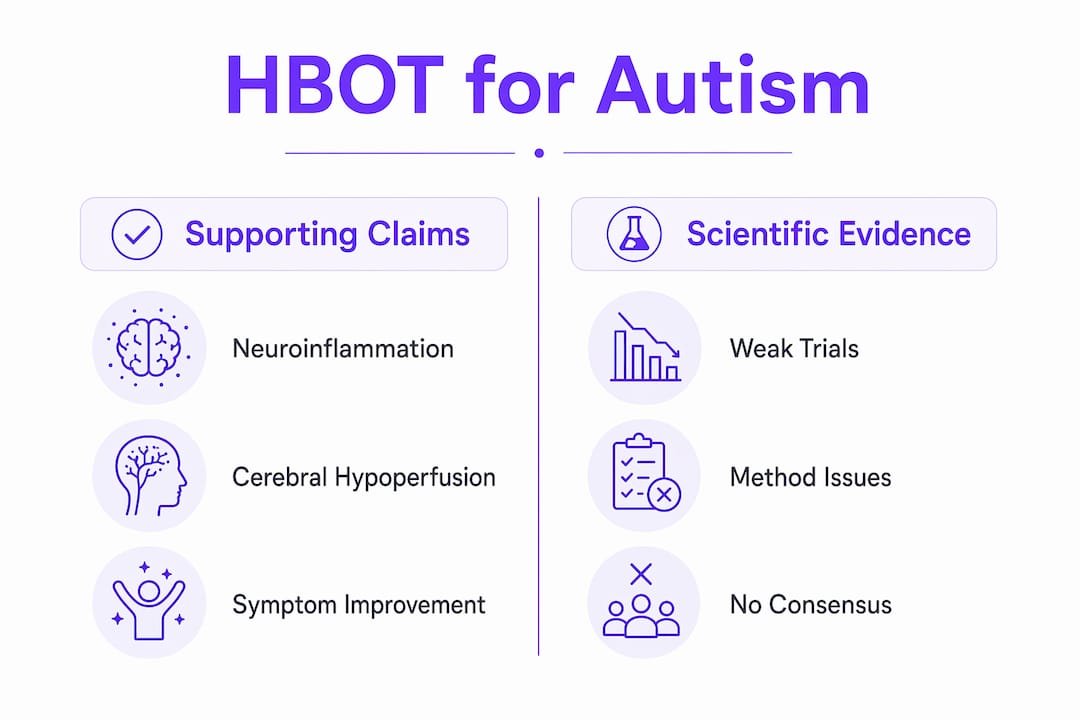
A randomised controlled trial involving 60 children with ASD found no significant differences between HBOT and sham treatment on the Autism Treatment Evaluation Checklist, whether rated by parents or clinicians. A separate US multicentre trial reported some improvements in physician-rated scores for receptive language and social interaction, but those results have not been replicated. A PubMed-indexed study using the Aberrant Behaviour Checklist found improvements in both the HBOT group and the non-HBOT control group, leading researchers to conclude the results did not support the utility of HBOT for autism.
Methodological concerns

Many studies suffer from significant methodological limitations, including small sample sizes, absence of control groups, and reliance on subjective parent-reported outcomes. These weaknesses make it impossible to draw firm conclusions from positive findings.
Expert and regulatory positions
The Association for Science in Autism Treatment cautions that therapies appearing logically consistent may still lack rigorous peer-reviewed support. The Undersea and Hyperbaric Medical Society similarly calls for far more rigorous research protocols before any endorsement. A large-scale review cited by the Raising Children Network found no evidence that HBOT helps with any characteristics of autism. Current research also confirms no longitudinal data demonstrating lasting effects or sustained safety for autistic individuals.
The neuroinflammation and cerebral hypoperfusion hypotheses remain unconfirmed by controlled trials, and HBOT for autism is widely categorised as experimental by mainstream clinical bodies.
How does HBOT fit within holistic wellness and spa therapies?
HBOT has well-established, approved medical uses, including treatment of decompression sickness, carbon monoxide poisoning, and arterial insufficiency. Beyond these clinical applications, it is increasingly incorporated into wellness and spa settings for general health optimisation.
In a holistic wellness context, HBOT is valued for:
- Enhanced tissue oxygenation and cellular recovery
- Support for relaxation and stress reduction
- Potential immune system support and general vitality
- Complementary use alongside other therapies such as infrared sauna, cold plunge, and mindfulness practices
These wellness applications are entirely distinct from claims about autism symptom improvement. At Live5dhealth, HBOT is offered as part of a combined holistic wellness programme designed to support your overall wellbeing, not as a clinical intervention for neurodevelopmental conditions. The focus is on helping you feel your best through evidence-informed, complementary therapies in a serene, supportive environment.
Pro Tip: If you are drawn to HBOT for its wellness benefits, approach it as a complementary tool for recovery and relaxation rather than a treatment for any specific medical condition. This mindset allows you to enjoy its genuine benefits without unrealistic expectations.
Choosing the right support: professional guidance and evidence-based autism interventions
If you or someone you care for is navigating autism spectrum disorder, the most empowering step you can take is consulting a qualified healthcare specialist experienced in ASD. HBOT’s appeal is understandable, but clinicians consistently prioritise interventions with a strong evidence base.
Evidence-based autism interventions recognised by clinicians include:
- Applied Behaviour Analysis (ABA) therapy
- Speech and language therapy
- Occupational therapy
- Social skills training programmes
- Cognitive behavioural therapy (CBT) for co-occurring anxiety
Safety considerations for HBOT you should know:
- Ear barotrauma is the most common adverse effect, particularly relevant for children who may struggle to equalise pressure
- Claustrophobia can be distressing in enclosed chamber environments
- Fatigue and headaches are reported by some users after sessions
- Home-use HBOT chambers vary widely in safety and efficacy compared to professional medical facilities
- Sessions are costly and require specialist facilities for appropriate monitoring
Critically evaluating any alternative therapy is not pessimism. It is good self-advocacy. The contraindications and safety profile of HBOT deserve careful review before you commit to a course of treatment.
Pro Tip: If you want to explore HBOT alongside mainstream autism support, discuss it openly with your child’s specialist first. Integrating complementary therapies safely means keeping your clinical team fully informed.
Key takeaways
HBOT is not currently supported by scientific evidence as an effective treatment for autism spectrum disorder, and major health bodies actively caution against its use for this purpose.
| Point | Details |
|---|---|
| HBOT definition and mechanism | Breathing pure oxygen in a pressurised chamber to increase oxygen delivery and potentially reduce neuroinflammation. |
| Lack of scientific support | Major clinical trials and health bodies find no confirmed benefit of HBOT for core autism symptoms. |
| Wellness vs. clinical use | HBOT has genuine wellness applications for recovery and oxygenation, entirely distinct from autism treatment claims. |
| Prioritise evidence-based care | Clinicians recommend ABA, speech therapy, and occupational therapy as first-line autism interventions. |
| Safety awareness | Side effects including ear barotrauma, claustrophobia, and fatigue require professional supervision during HBOT sessions. |