

Hyperbaric oxygen therapy (HBOT) is defined as a medical treatment in which you breathe pure oxygen inside a pressurised chamber, typically at 2.0–2.4 ATA, to accelerate cellular repair and healing. The standard HBOT sessions per week protocol for clinical healing conditions is 5 sessions per week, with each session lasting 60–120 minutes. Whether you are managing a chronic wound, supporting cancer treatment, or seeking general wellness benefits, the number and frequency of sessions you need depends on your specific condition, the pressure used, and how your body responds over time. Getting this right from the start makes a measurable difference to your outcomes.
What is the standard HBOT sessions per week protocol for clinical healing?
Clinical HBOT protocols for FDA-cleared conditions generally prescribe 20–40 sessions at 5 days per week, with each session lasting 60–120 minutes at pressures between 2.0 and 2.4 ATA. This frequency is not arbitrary. Daily sessions, five days per week, sustain the cellular repair mechanisms that make HBOT effective, particularly angiogenesis, which is the formation of new blood vessels in damaged tissue.
For neurological conditions such as traumatic brain injury (TBI) or stroke recovery, the demands are higher. Intensive neurological rehabilitation protocols often require 40–80 sessions at 5 days per week over 12 weeks. That is a significant commitment, but the research supports it. Reducing frequency in these cases measurably slows recovery.

Here is a summary of standard clinical protocols by condition type:
| Condition | Sessions per week | Total sessions | Pressure (ATA) | Session length |
|---|---|---|---|---|
| Chronic wounds | 5 | 20–40 | 2.0–2.4 | 60–90 mins |
| Radiation injury | 5 | 30–40 | 2.0–2.4 | 90–120 mins |
| TBI / stroke rehab | 5 | 40–80 | 2.0–2.4 | 60–90 mins |
| Carbon monoxide poisoning | 5 | 3–10 | 2.4–3.0 | 90 mins |
Key features of a well-structured clinical HBOT schedule include:
- Daily sessions Monday to Friday, with weekends as rest days
- Slow pressurisation and depressurisation at the start and end of each session, which is when patients notice the most physical sensation
- Reassessment every 20 sessions to evaluate progress and adjust the plan
- Consistent spacing between sessions to prevent plateauing in vascular and cellular repair
Pro Tip: If you miss a session, do not try to double up the following day. Speak to your clinician about rescheduling, as the spacing between sessions is as important as the total count.
The 5-day weekly schedule originates from wound care research and has been validated across multiple clinical settings. Skipping days without medical guidance undermines the biological processes the therapy is designed to trigger.
How do HBOT session frequencies differ for wellness and fitness purposes?
Wellness and biohacking HBOT protocols typically involve 1–3 sessions per week, which is significantly less frequent than clinical standards. This lower frequency reflects both the milder pressures used and the absence of an acute medical condition requiring intensive repair.
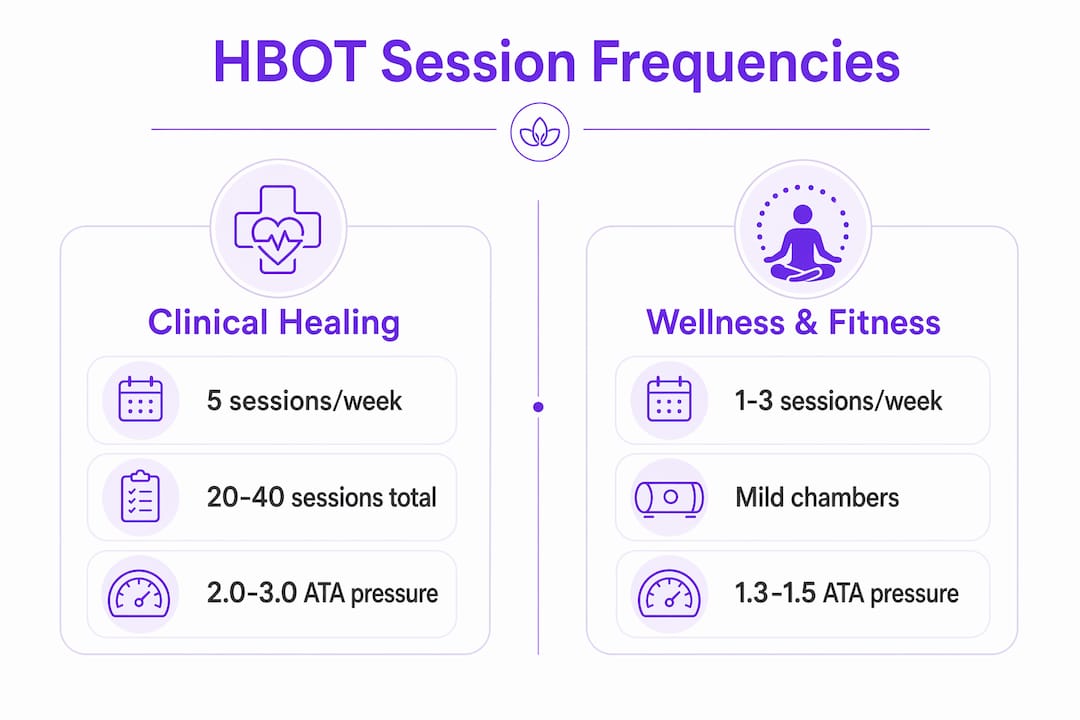
The pressure difference matters enormously here. Clinical-grade HBOT uses hard-shell chambers at 2.0–3.0 ATA, while mild HBOT uses soft-shell chambers at 1.3–1.5 ATA. Mild soft-shell HBOT at these lower pressures often does not trigger the systemic physiological changes seen at higher clinical pressures. This means the protocols for one cannot simply be applied to the other.
| Feature | Clinical HBOT | Wellness HBOT |
|---|---|---|
| Pressure | 2.0–3.0 ATA | 1.3–1.5 ATA |
| Sessions per week | 5 | 1–3 |
| Total sessions | 20–80 | 10–20 (varies) |
| Evidence base | Strong (FDA-cleared) | Limited for most claims |
| Supervision | Medical team required | Often self-directed |
Common wellness uses for lower-frequency HBOT include:
- Anti-ageing and skin health, where 2 sessions per week over 8–10 weeks is a typical cycle
- Athletic recovery, where 1–2 sessions per week post-training is common
- General energy and cognitive support, often using 10-session introductory blocks
- Maintenance cycles following a completed clinical course
The clinical wound care protocol of 5 sessions per week for 40 sessions is aggressive for wellness purposes and lacks direct evidence when applied to cosmetics or longevity goals. Wellness centres that extrapolate clinical frequencies to anti-ageing programmes may lead patients toward overtreatment and unnecessary expense.
Pro Tip: If you are using mild HBOT for wellness, lower pressure may require longer or more frequent sessions to achieve comparable effects. Ask your provider to explain the specific oxygen dose you are receiving, not just the session count.
How to personalise your HBOT therapy for cancer or chronic healing needs
Personalising your hyperbaric therapy protocol starts with a thorough medical evaluation before your first session. There is no universal session count that works for every person with cancer or a chronic condition. Your clinician needs a baseline assessment to set a meaningful starting point.
Adjusting HBOT therapy based on measurable physiological response, rather than fixed protocols, leads to more successful outcomes. This means your session frequency and total count should be reviewed regularly, not locked in at the start. The markers used to guide these adjustments include:
- Wound size measurements taken at regular intervals to track tissue regeneration
- Cognitive function tests for neurological conditions, assessed before and after treatment blocks
- Inflammatory markers from blood tests, reviewed at reassessment points
- Subjective symptom scores, including pain, fatigue, and sleep quality
- Imaging results for tumour-related applications, reviewed in coordination with your oncologist
For cancer patients, HBOT is used as a supportive therapy alongside conventional treatment, not as a standalone cure. You can read more about HBOT and cancer support to understand how session frequency recommendations apply specifically to oncology contexts. The frequency and pressure used must be agreed with your oncology team, as some protocols are contraindicated during active chemotherapy.
“Effective HBOT treatment plans are dynamic, with reassessment intervals typically every 20 sessions, guiding continuation or adjustment based on clinical tests or wound size metrics.” — Trufamed clinical guidance
Risks of inconsistent or too infrequent sessions are real. Spacing sessions too far apart reduces the biological effect of the therapy. Doing 40 sessions once a month, for example,
undermines treatment efficacy in the same way that taking antibiotics sporadically fails to clear an infection. Consistency is the mechanism.
Pro Tip: Before starting any HBOT programme for cancer or chronic illness, review the HBOT safety checklist with your clinician. Some conditions and medications require protocol adjustments before you begin.
What are common HBOT scheduling formats and how do you stay consistent?
The most common clinical HBOT schedule runs Monday to Friday, with Saturday and Sunday as rest days. This structure maps neatly onto a working week and makes it easier to build the therapy into your routine. A 40-session course at 5 days per week takes 8 calendar weeks. An 80-session neurological protocol takes 16 weeks.
Practical scheduling considerations include:
- Travel time and proximity to the treatment centre, which affects long-term adherence
- Cost per session, which accumulates quickly over 40–80 sessions and should be factored into your plan from the start
- Employer or carer commitments, which may require morning or late-afternoon appointment slots
- Fatigue after sessions, as some patients feel tired following treatment and need recovery time built into their day
A typical phased schedule for a 40-session course might look like this:
- Weeks 1–4: 5 sessions per week, full clinical dose, establishing the therapeutic baseline
- Week 4 reassessment: Review wound size, cognitive scores, or imaging with your clinician
- Weeks 5–8: Continue at 5 sessions per week or adjust frequency based on response
- End of course review: Decide whether a maintenance phase at 1–2 sessions per week is appropriate
Consistent session spacing avoids plateauing in cellular and vascular repair processes. This is especially important in chronic wounds and neurological conditions, where the repair cascade depends on sustained oxygen delivery over time. Missing more than two consecutive sessions without medical guidance risks losing the cumulative benefit built up to that point.
A typical HBOT session lasts 60–120 minutes, with the slow pressure changes at the start and end being the most physically noticeable part. Most patients adapt to this sensation within the first 3–5 sessions. Planning your schedule around this total time commitment, including travel and recovery, helps you stay on track for the full course.
Key takeaways
The most effective HBOT sessions per week protocol for clinical healing is 5 sessions weekly, sustained consistently over 20–80 sessions depending on condition severity and physiological response.
| Point | Details |
|---|---|
| Clinical standard frequency | Five sessions per week, 60–120 minutes each, at 2.0–2.4 ATA for most healing conditions. |
| Total sessions by condition | Chronic wounds need 20–40 sessions; neurological rehab typically requires 40–80 sessions. |
| Wellness protocols differ | Wellness HBOT uses 1–3 sessions per week at lower pressures, with a weaker evidence base. |
| Reassess every 20 sessions | Review measurable markers at each 20-session interval to adjust frequency or pressure. |
| Consistency is the mechanism | Spacing sessions too far apart reduces biological effect and undermines cumulative gains. |
What I have learned about HBOT frequency after years in wellness
The single biggest mistake I see people make with HBOT is treating it like a gym session. They do a few sessions when they feel motivated, skip a week, then wonder why they are not seeing results. That is not how this therapy works. The biological effects of HBOT are cumulative and frequency-dependent. You cannot compress 40 sessions into 20 and expect the same outcome.
What I have also found is that the pressure distinction between clinical and mild HBOT is genuinely misunderstood, even by people who have done their research. Patients arrive having read about 40-session protocols and assume their soft-shell wellness sessions follow the same rules. They do not. A pressurised oxygen session at 1.3 ATA delivers a fundamentally different oxygen dose to one at 2.4 ATA. Applying clinical frequency expectations to a mild HBOT programme sets people up for disappointment.
My practical advice is this: if you are using HBOT for a serious condition, including cancer support or neurological recovery, work with a clinician who will reassess your markers every 20 sessions and adjust your plan accordingly. If you are using it for wellness, be honest about what the evidence does and does not support. Two well-dosed sessions per week at the right pressure, with proper monitoring, will serve you far better than five rushed sessions with no baseline assessment.
— Mark
HBOT programmes at Live5dhealth: personalised and results-focused
Live5dhealth, based in Boyle, County Roscommon, offers personalised HBOT programmes designed around your specific healing goals, whether you are managing a chronic condition, supporting cancer treatment, or pursuing a structured wellness protocol.

Every programme at Live5dhealth begins with a consultation to establish your baseline and set a realistic session schedule. The centre also offers complementary therapies including sauna, cold plunge, and steam facilities that support recovery between sessions. For those exploring wellness centre options in Ireland, Live5dhealth provides a genuinely integrated approach to healing. Visit live5dhealth.com to review current HBOT programme options and book your initial consultation.
FAQ
How many HBOT sessions per week is standard for healing?
The clinical standard is 5 sessions per week, typically Monday to Friday, for conditions such as chronic wounds, radiation injury, and neurological rehabilitation. This frequency sustains the cellular repair mechanisms that make HBOT effective.
How many HBOT sessions are needed in total?
Most clinical protocols require 20–40 sessions for wound-based conditions and 40–80 sessions for neurological rehabilitation. Your clinician should reassess your progress every 20 sessions to confirm whether continuation is warranted.
Is 1–2 sessions per week enough for wellness benefits?
For general wellness and mild HBOT at 1.3–1.5 ATA, 1–3 sessions per week is the typical recommendation. This frequency is not supported by the same level of clinical evidence as 5-day protocols and should not be applied to serious medical conditions.
What happens if I miss sessions during my HBOT course?
Missing sessions disrupts the consistent oxygen delivery that drives angiogenesis and cellular repair. Spacing sessions too far apart measurably reduces treatment efficacy, so speak to your clinician promptly if you need to reschedule.
Does pressure affect how often I need HBOT sessions?
Yes. Lower pressure chambers at 1.3–1.5 ATA deliver a smaller oxygen dose per session, which may require longer or more frequent sessions to approach the effects seen at clinical pressures of 2.0–2.4 ATA. Always confirm the pressure and dose with your provider before committing to a schedule.