
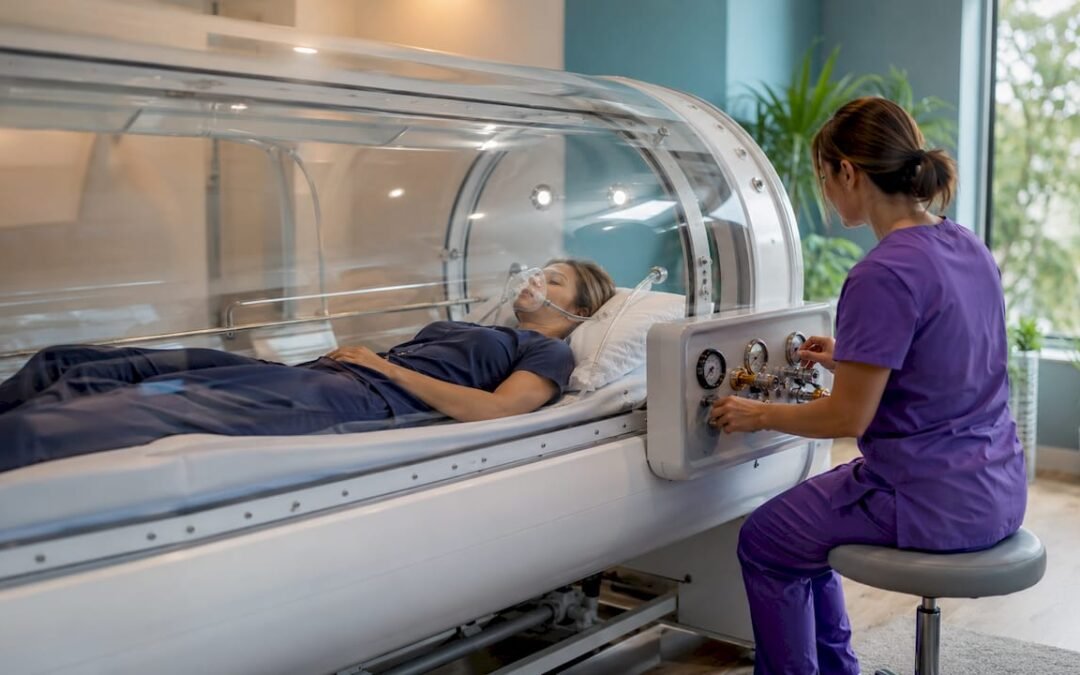
Pressurised oxygen is defined as pure oxygen delivered at atmospheric pressures above normal, forcing far greater quantities of oxygen to dissolve directly into blood plasma. This is the mechanism behind hyperbaric oxygen therapy (HBOT), the recognised clinical term for this treatment. At standard atmospheric pressure, haemoglobin carries almost all the oxygen your blood transports. Under pressure, that changes dramatically. Breathing 100% oxygen at 3 ATA raises total blood oxygen content by 42%, with dissolved plasma oxygen exceeding twenty times its normal level. That means oxygen reaches tissues that compromised circulation simply cannot serve through haemoglobin alone. HBOT is approved for conditions including decompression sickness, carbon monoxide poisoning, diabetic foot ulcers, and radiation injury, making it one of the most clinically versatile therapies in modern medicine.
What does pressurised oxygen do to blood oxygen levels?
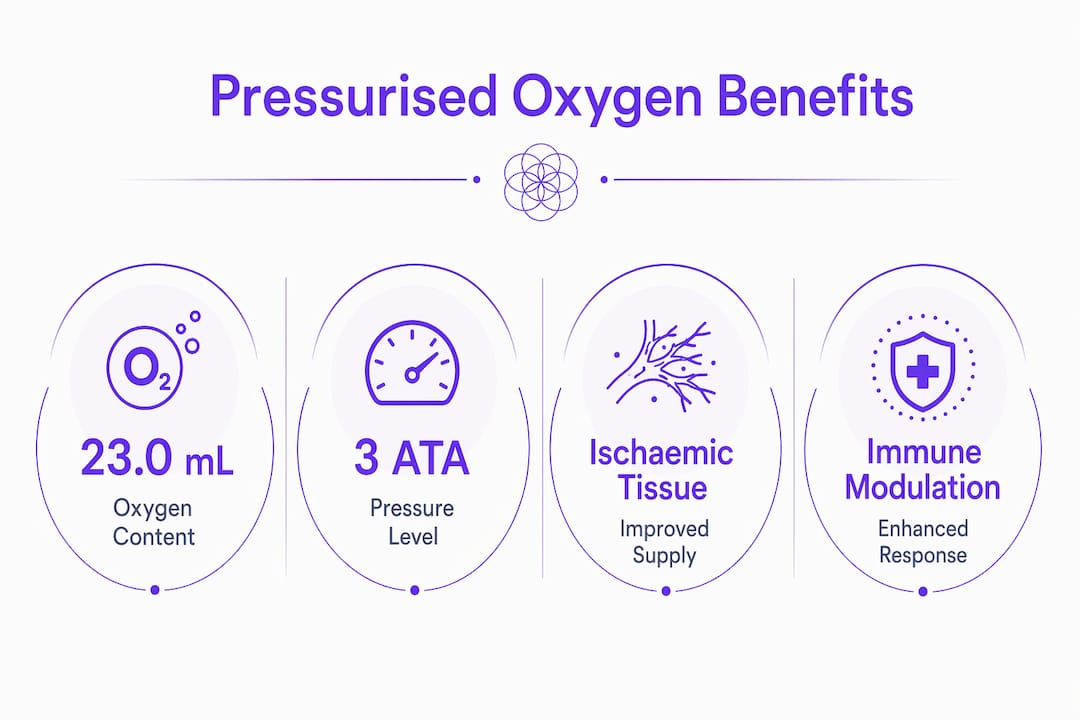
The physics behind HBOT comes down to Henry’s Law: the amount of gas dissolved in a liquid is directly proportional to the pressure applied. At normal atmospheric pressure, plasma carries very little dissolved oxygen. Haemoglobin does the heavy lifting, transporting around 97% of all oxygen in the blood. Pressure changes that equation entirely.
| Condition | Total O₂ content (mL O₂/dL) | Dissolved plasma O₂ |
|---|---|---|
| Normal air, 1 ATA | 16.2 | Minimal |
| 100% O₂ at 3 ATA | 23.0 | 20× normal levels |
Combined oxygen content rises from 16.2 mL O₂/dL to 23.0 mL O₂/dL at 3 ATA. That is not a marginal gain. It means plasma itself can meet resting tissue oxygen demands without any contribution from haemoglobin, which is critical when blood vessels are damaged or blocked.
This matters enormously for ischaemic tissue, where blood flow is restricted. Dissolved oxygen diffuses further and faster than oxygen bound to red blood cells. It penetrates oedematous tissue, crosses scar tissue, and reaches cells that would otherwise remain starved of oxygen. HBOT leverages Henry’s and Boyle’s laws to push oxygen deeper into the body than normal circulation allows.
Pro Tip: If you are comparing oxygen therapies, ask specifically about the pressure level used. Supplemental oxygen at normal atmospheric pressure does not dissolve meaningfully into plasma and cannot replicate the effects of HBOT.
Understanding how oxygen therapy differs by type helps you ask the right questions before committing to any treatment programme.
What conditions benefit from pressurised oxygen therapy?
The therapeutic benefits of pressurised oxygen extend well beyond simply raising oxygen levels. Under hyperbaric conditions, oxygen acts as both a physiological and pharmacological agent. It promotes angiogenesis, reduces oedema, and enhances leukocyte bacterial-killing capacity, making it effective across a surprisingly wide range of clinical conditions.
The conditions most supported by clinical evidence include:
- Decompression sickness — caused by nitrogen bubbles forming in the blood after rapid ascent in diving; HBOT is the primary treatment.
- Carbon monoxide poisoning — pressurised oxygen displaces carbon monoxide from haemoglobin far more rapidly than breathing normal air.
- Diabetic foot ulcers — treatment at 1.5–2.4 ATA shows a number-needed-to-treat of around 4 at six weeks, meaning roughly one in four patients avoids amputation who would not have done so otherwise.
- Radiation-induced tissue injury — radiation damages blood vessels; HBOT stimulates new vessel growth in irradiated tissue.
- Non-healing wounds — chronic wounds with poor vascular supply respond to the increased oxygen gradient HBOT creates.
The cellular mechanisms driving these outcomes are equally impressive. A single HBOT session can increase circulating CD34+ stem cells eightfold, mobilising the body’s own repair cells. Repeated sessions sustain this effect, compounding the healing response over a course of treatment.
The effects of pressurised oxygen also include meaningful immune modulation. Learn more about HBOT’s immune effects and how they contribute to recovery from infection and inflammation. Collagen synthesis increases, inflammation reduces, and the local environment around a wound shifts from one that resists healing to one that actively supports it.
Mild HBOT vs clinical HBOT: does pressure level matter?
Pressure level is the single most important variable in oxygen therapy. This is where a great deal of confusion exists, particularly as mild hyperbaric chambers become more common in wellness settings.
| Pressure level | ATA | Oxygen dose relative to clinical HBOT | Primary use |
|---|---|---|---|
| Mild HBOT | 1.3 ATA | Approximately one-third | Wellness, recovery |
| Standard clinical | 2.0 ATA | Full therapeutic dose | Medical conditions |
| High clinical | 2.4 ATA | Maximum therapeutic dose | Complex wounds, CO poisoning |
Mild HBOT at 1.3 ATA delivers roughly one-third the oxygen dose of clinical HBOT at 2.4 ATA. That is a substantial difference. The clinical evidence base for conditions like diabetic ulcers, radiation injury, and decompression sickness is built entirely on higher-pressure protocols. Applying wellness-level pressure to a medical condition is not equivalent.
Simply breathing supplemental oxygen at normal atmospheric pressure does not achieve the therapeutic benefits of HBOT. The pressure component is what forces oxygen into plasma. Without it, you are not delivering meaningfully more oxygen to ischaemic tissue regardless of the concentration you breathe.
At 2.4 ATA, plasma alone can meet resting tissue oxygen needs without haemoglobin. This is the threshold that makes HBOT genuinely transformative for ischaemic tissue recovery. Mild HBOT may support general wellness and recovery, but it operates through a different physiological mechanism and should not be presented as a clinical substitute.
Pro Tip: When evaluating any hyperbaric facility, ask for the specific ATA pressure used and whether the chamber delivers 100% oxygen or ambient air under pressure. Both factors determine the actual oxygen dose you receive.
What are the side effects of pressurised oxygen therapy?
HBOT is well tolerated by most people, but it is not without risks. Understanding these before you begin is part of making an informed decision about your health.
The most common side effects include:
- Ear barotrauma — pressure changes can cause discomfort or injury to the middle ear, similar to the sensation during aircraft descent. Equalising technique reduces this risk significantly.
- Temporary vision changes — some patients experience myopia during a course of treatment. This typically resolves within weeks of completing therapy.
- Hypoglycaemia — insulin-dependent diabetics are at particular risk of low blood sugar during sessions. HBOT requires monitoring and blood glucose checks before and after treatment.
- Oxygen toxicity — at very high pressures or with prolonged exposure, excess oxygen can cause seizures. Clinical protocols are designed specifically to stay within safe limits.
- Claustrophobia — monoplace chambers (single-person tubes) can trigger anxiety in some individuals. Multiplace chambers, where patients sit in a larger pressurised room, offer an alternative.
Patients require pre-treatment screening to identify contraindications. Untreated pneumothorax (collapsed lung) is an absolute contraindication. Certain medications, recent ear surgery, and active respiratory infections also require careful assessment before treatment begins.
The safety protocols in clinical HBOT are well established and designed to minimise adverse events. Choosing a regulated clinical environment with trained staff is the most important step you can take to protect yourself.
Key takeaways
Pressurised oxygen therapy works because increased atmospheric pressure forces oxygen to dissolve directly into blood plasma, enabling it to reach tissues that normal haemoglobin-based delivery cannot serve.
| Point | Details |
|---|---|
| Plasma oxygen is the key mechanism | Pressure dissolves oxygen directly into plasma, bypassing haemoglobin to reach ischaemic tissue. |
| Clinical pressure levels matter | At 2.4 ATA, plasma oxygen alone can meet tissue needs; mild HBOT at 1.3 ATA delivers roughly one-third of this dose. |
| Stem cell mobilisation supports healing | A single HBOT session can increase circulating CD34+ stem cells eightfold, accelerating tissue repair. |
| Approved clinical conditions are specific | HBOT is clinically validated for decompression sickness, CO poisoning, diabetic ulcers, and radiation injury. |
| Safety screening is non-negotiable | Pre-treatment assessment for contraindications and monitoring during sessions protects patient safety. |
Why I think pressure dosing is the conversation nobody is having
I have watched the wellness industry embrace mild hyperbaric chambers with real enthusiasm, and I understand the appeal. They are accessible, relatively affordable, and the experience is comfortable. But the conversation around pressure dosing is almost entirely absent from mainstream wellness marketing, and that concerns me.
The clinical evidence for HBOT was built at 2.0 ATA and above. When someone with a diabetic foot ulcer or radiation-damaged tissue sits in a 1.3 ATA chamber, they are receiving a fraction of the oxygen dose that the research supports. That is not a small distinction. It is the difference between a therapeutic intervention and a wellness experience.
What I find genuinely exciting is the expanding evidence for HBOT in neurological recovery, including applications for acute brain injury and conditions where conventional medicine has limited options. The vasoconstriction effect of hyperoxia actually reduces cerebral oedema while maintaining oxygen delivery to the brain. That is a remarkable and counterintuitive finding that deserves far more attention.
My advice is straightforward. If you are exploring HBOT for a specific medical condition, seek a clinical facility operating at 2.0 ATA or above, with a physician overseeing your protocol. If you are using mild HBOT for general recovery and wellbeing, enjoy it for what it is. Just do not conflate the two. Pressure dosing is not a technicality. It is the entire mechanism.
— Mark
Explore oxygen therapy and wellness at Live5dhealth
If this article has sparked your interest in what pressurised oxygen can do for your health, you are in the right place. Live5dhealth is a wellness centre, luxury spa, gym, and retreat in Boyle, County Roscommon, offering a range of therapies and recovery options designed to support your health from the inside out.

Whether you are looking for a structured recovery programme, a luxury wellness retreat in the west of Ireland, or simply want to explore the wellness centres near you that offer advanced health therapies, Live5dhealth can help you find the right path. Our team is here to guide you through your options with honesty and expertise. Visit us at Live5dhealth to learn more and take the next step towards feeling your best.
FAQ
What does pressurised oxygen do that normal oxygen cannot?
Pressurised oxygen dissolves directly into blood plasma under increased atmospheric pressure, reaching tissues that haemoglobin-bound oxygen cannot access. Normal supplemental oxygen at standard pressure does not achieve this plasma saturation effect.
How does oxygen pressure work in hyperbaric therapy?
Pressure inside a hyperbaric chamber forces oxygen to dissolve into plasma according to Henry’s Law. At 3 ATA, total blood oxygen content rises by 42%, with dissolved plasma oxygen reaching more than twenty times its normal level.
What are the main uses of high-pressure oxygen therapy?
Clinical HBOT is approved for decompression sickness, carbon monoxide poisoning, diabetic foot ulcers, radiation-induced tissue injury, and non-healing wounds, typically at pressures between 1.5 and 2.4 ATA.
Is pressurised oxygen therapy safe?
HBOT is safe when delivered in a regulated clinical setting with appropriate screening. Side effects can include ear barotrauma, temporary vision changes, and hypoglycaemia in diabetics, all of which are managed through established safety protocols.
What is the difference between mild and clinical HBOT?
Mild HBOT operates at around 1.3 ATA and delivers approximately one-third the oxygen dose of clinical HBOT at 2.4 ATA. Clinical protocols are supported by robust evidence for medical conditions; mild HBOT is primarily used in wellness and recovery contexts.