
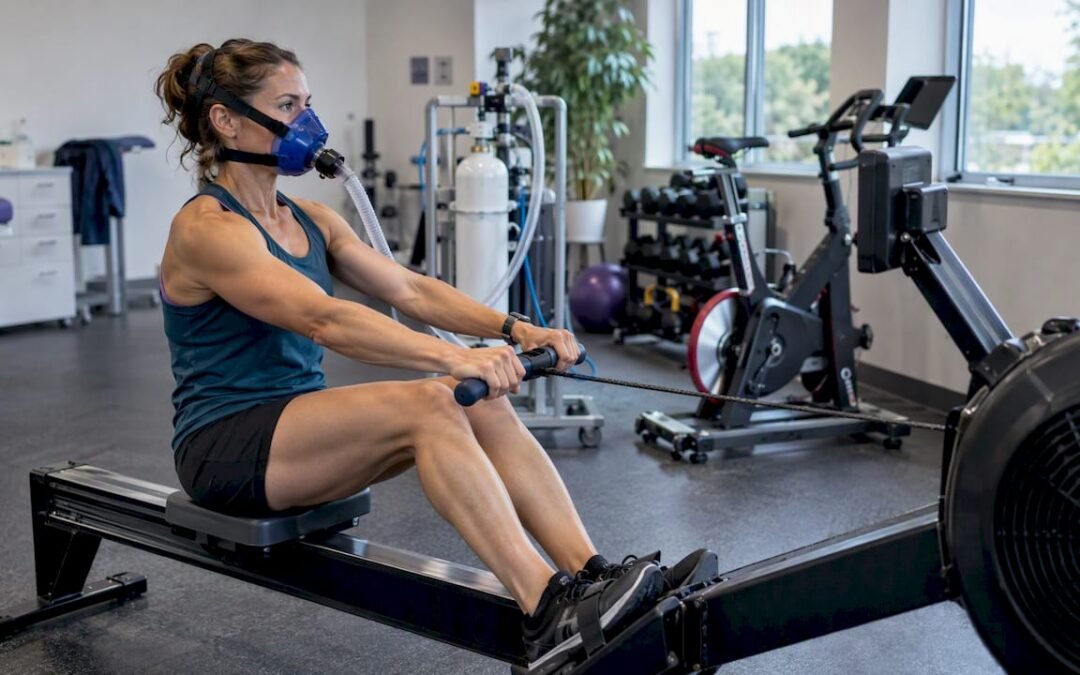
EWOT can give you a real, acute performance boost in a single session, but it isn’t a proven route to guaranteed long-term fitness gains. The honest approach treats it as a tool to trial and measure, not a shortcut to assume: your results will depend on the oxygen percentage used, your exercise mode, and your own physiology, so testing it against a matched room-air session (with medical clearance first) is the only way to know if it’s working for you.
TL;DR:
- Exercising with oxygen enrichment can improve acute performance, especially at FiO2 levels of 0.30 and higher, but long-term fitness gains remain unproven.
- The effectiveness of EWOT varies depending on exercise mode, protocol, and oxygen level, with individual responses requiring personalized testing.
- Comparing room air to oxygen-enriched sessions under controlled conditions is essential to determine real benefits for each athlete.
- Safety considerations include medical screening for respiratory, cardiac, or neurological conditions, as oxygen is a regulated medical product.
- Hyperbaric oxygen therapy differs from EWOT and offers limited evidence for performance enhancement, making EWOT more relevant during actual exercise.
Table of Contents
- What EWOT is and how it works
- What the research says about acute gains versus long-term training effects
- EWOT versus HBOT and other oxygen approaches
- Practical protocols for using EWOT in training
- Safety, contraindications and oxygen regulation
- How to measure whether EWOT is actually helping you
- A practitioner’s view on trialling EWOT
- Try EWOT at Live5DHealth with supervised testing
- FAQ
- Sources
What EWOT is and how it works
Exercise With Oxygen Therapy means training while breathing air enriched with extra oxygen, known clinically as normobaric hyperoxia. Most delivery methods use a mask or nasal cannula connected to an oxygen concentrator while you cycle, row or run at a set intensity.
The key variable is FiO2, the fraction of inspired oxygen. Room air sits at roughly 0.21. Research on hyperoxia and exercise performance found that an FiO2 of 0.30 or higher tends to produce benefits, and many trials push as high as 1.00 (pure oxygen) to study maximum effect.
Breathing richer air raises the oxygen content in your blood, which can ease the load on your heart and lungs during hard efforts and delay the point where your muscles run short of oxygen. That’s the physiological reason time to exhaustion and submaximal endurance sometimes improve under hyperoxia, and why oxygen supports tissue repair more broadly in the body.
What the research says about acute gains versus long-term training effects
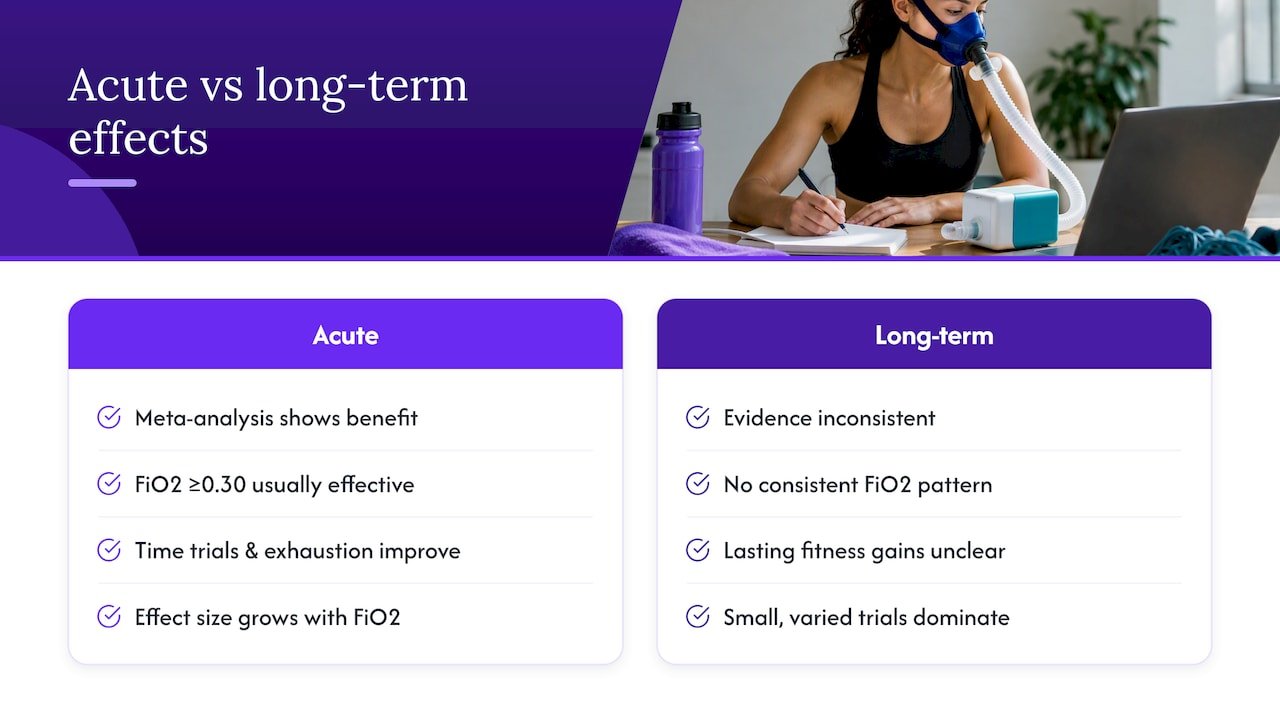
The clearest finding across the literature is a split between what happens in a single session and what happens over a training block. A 2017 meta-analysis in Sports Medicine concluded that exercising with supplemental oxygen can improve acute performance, with FiO2 levels of 0.30 and above generally showing benefit, and higher oxygen fractions associated with larger acute effects.
A narrative review covering 89 studies found that acute improvements in endurance and high-intensity exercise can vary considerably depending on test and oxygen level used, reflecting how exercise mode and protocol shape the outcome. Time to exhaustion tests and time trials tend to show the clearest gains, since they capture the extra seconds or watts hyperoxia can buy you before fatigue sets in.
What the same body of work can’t tell you is whether repeated EWOT sessions build lasting fitness adaptations. Long-term training evidence remains inconclusive, largely because trials use different FiO2 levels, different exercise modes and small participant numbers, which makes pooling the data into a single reliable answer difficult. Few studies run long enough to separate a genuine training adaptation from a string of good single-session days.
For you as an athlete, this means group-level effect sizes from a review don’t predict your individual response. One clinical-review perspective suggests oxygen supplementation makes the most sense when you have a demonstrable limitation, such as exercise-induced desaturation, rather than as a blanket upgrade for every healthy competitor. The practical takeaway is to treat any published effect size as a hypothesis to test on yourself, not a result to bank on.
EWOT versus HBOT and other oxygen approaches
Hyperbaric oxygen therapy delivers oxygen at increased atmospheric pressure inside a sealed chamber, a different mechanism entirely from breathing enriched air at normal pressure during exercise. HBOT requires dedicated pressurised equipment and is typically administered before or after activity rather than during it.
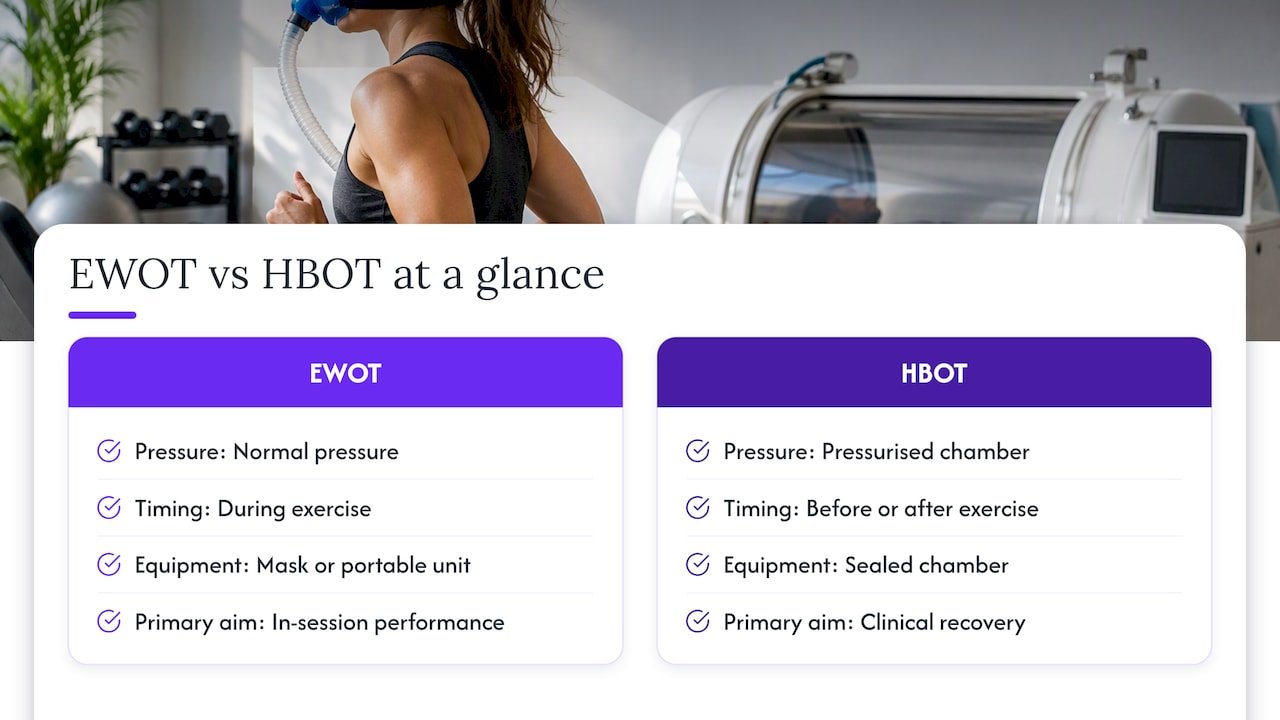
A 2021 systematic review and meta-analysis found that pre- and post-exercise hyperbaric oxygen produced no significant effect on performance or recovery across pooled studies, though intra-exercise HBOT occasionally improved muscle endurance in individual trials. That distinction matters for how you choose between the two: EWOT’s strength lies in boosting oxygen delivery while you’re actually working, which is exactly when hyperoxia has the most to offer. HBOT tends to suit clinical recovery goals or specialist programmes rather than in-session performance aims. For a deeper look at how exercising with oxygen differs from hyperbaric sessions, the mechanisms and typical uses are worth comparing side by side.
Practical protocols for using EWOT in training
Before you trial EWOT, decide on four things: your target FiO2, your delivery method, the intensity and duration of the session, and how you’ll monitor it. Blood oxygen saturation (SpO2), rate of perceived exertion and your power or time output are the minimum data points worth tracking every session.
Literature-based starting points suggest an FiO2 of around 0.30 as a reasonable baseline, since reviews report small benefits from that level upward, with larger acute gains tending to appear at higher oxygen fractions; some endurance athletes also use Cordyceps pre workout for endurance athletes as an adjunct to training. Many published protocols use session lengths of 15 to 30 minutes at moderate to high intensity, though exact timing varies considerably between studies.
A simple trial plan looks like this:
- Baseline session: complete your chosen workout (time trial, interval set or endurance test) breathing room air, and log every metric.
- Washout period: rest at least 48 to 72 hours before the next test to avoid residual fatigue skewing results.
- EWOT session: repeat the identical workout, same warm-up, same time of day, this time breathing oxygen-enriched air at your target FiO2.
- Compare outcomes: look at time, power, SpO2 and RPE side by side rather than relying on how the session felt.
- Repeat if unclear: run a second matched pair if the first comparison is ambiguous, since a single data point can mislead.
Pro Tip: Keep nutrition, sleep and warm-up identical across both sessions, because any one of those variables can produce a bigger swing in performance than the oxygen itself. Further detail on what the evidence actually supports for EWOT is worth reviewing before you set your protocol.
Safety, contraindications and oxygen regulation
Concentrated oxygen isn’t a risk-free fitness accessory, and some athletes shouldn’t use it without medical oversight. Screening matters as much as the protocol itself.
- Respiratory conditions: COPD and other chronic lung diseases can make supplemental oxygen dangerous without clinical supervision.
- Prior bleomycin exposure: this chemotherapy drug increases lung sensitivity to oxygen toxicity even years later.
- Seizure history or certain cardiac and eye conditions: these require a clinician’s assessment before any oxygen-enriched exercise.
- Fire risk: concentrated oxygen environments need proper ventilation and equipment maintenance to avoid combustion hazards.
Irish long-term oxygen therapy guidance treats oxygen as a regulated medicinal product requiring clinical assessment and proper flow titration, not something to self-administer casually. Facilities offering EWOT should confirm their equipment’s conformity documentation and ensure a clinician or trained practitioner oversees sessions, with consent and medical clearance documented beforehand. A full breakdown of who should avoid EWOT and why is worth reading if any of the above applies to you.
How to measure whether EWOT is actually helping you
The only reliable way to know if EWOT works for you is a controlled comparison, not a gut feeling after one good session.
- Design a matched pair: run the same workout on room air and on EWOT, with identical nutrition, sleep and warm-up beforehand.
- Collect objective numbers: time trial result, power output, time to exhaustion, heart-rate recovery and RPE, plus SpO2 or lactate if you have access to the equipment.
- Set a decision threshold: a consistent, repeatable improvement across two or more matched trials is more meaningful than a one-off gain, and marginal or inconsistent results suggest the effect isn’t worth the added cost or complexity for you.
- Loop in a professional: if you have any underlying health condition or the results are ambiguous, a clinician or coach should review your data before you commit to ongoing use.
A practitioner’s view on trialling EWOT
We’d rather see an athlete run two carefully matched sessions and look at the numbers than take a single good workout as proof. EWOT earns its place in training when it’s tested, supervised and measured, never assumed.
That means pairing any EWOT trial with proper screening, objective data, and enough recovery between sessions to see the real signal.
— Mark
Try EWOT at Live5DHealth with supervised testing
We offer Exercise with Oxygen Therapy as part of a wider range of recovery and oxygen-based therapies, which means you can trial EWOT alongside objective monitoring rather than guessing at results on your own.

Before your first session, we ask about any underlying health conditions so we can flag anything that needs clearance from your doctor first, particularly if you have a respiratory or cardiac history. Once cleared, we’d suggest running the matched trial plan outlined above under practitioner oversight, so you can compare a room-air session against an EWOT session on the same metrics.
- Book a supervised EWOT session through our booking page and bring your baseline numbers from a recent workout.
- Combine it with recovery support such as our hyperbaric oxygen therapy if your goals extend beyond in-session performance.
- Ask about medical screening before your appointment to ensure your trial is both safe and useful.
This article is general information, not a substitute for advice from a qualified doctor. Consult a qualified healthcare professional about your own circumstances before acting on anything here.
FAQ
Is EWOT as good as HBOT for athletic performance?
They work differently, so “better” depends on your goal. EWOT research shows acute performance benefits during exercise, while a systematic review of HBOT found no significant effect from pre- or post-exercise sessions, making EWOT the more relevant choice for in-session performance goals.
Does EWOT increase VO2 max?
The evidence doesn’t support a reliable long-term VO2 max increase from EWOT. Acute sessions can improve time to exhaustion and time-trial performance while you’re breathing the enriched air, but long-term training adaptation data remains inconclusive due to small sample sizes and varied protocols.
Is EWOT safe to try?
For most healthy adults it can be, provided it’s supervised and you’ve been medically screened first. Certain conditions, including COPD, prior bleomycin exposure and some cardiac or eye conditions, require clinical assessment beforehand, and Irish oxygen therapy guidance treats supplemental oxygen as a regulated medicinal product rather than an unsupervised fitness tool.
Can hyperbaric oxygen therapy be used for sports recovery?
It can be used for recovery, though the evidence for performance benefit is mixed. The same 2021 meta-analysis found no significant effect from pre- or post-exercise HBOT on recovery outcomes overall, though intra-exercise use occasionally helped muscle endurance in individual studies, so it suits clinical or specialist recovery programmes more than routine post-workout use.
What FiO2 should athletes use for EWOT?
Most published benefit starts around an FiO2 of 0.30, with some reviews reporting larger acute gains at higher oxygen fractions. The right level for you depends on your sport, your baseline fitness and medical clearance, which is why a matched trial against room air is the safest way to find your own starting point.
Sources
- Influence of Hyperoxia on Exercise Performance: A Systematic Review and Meta-analysis (Sports Medicine, 2017)
- The Effects of Hyperoxia on Sea-Level Exercise Performance, Training and Recovery (narrative review)
- Effects of Pre-, Post- and Intra-Exercise Hyperbaric Oxygen Therapy on Performance and Recovery: A Systematic Review and Meta-Analysis (Frontiers/Physiology, 2021)
- Irish guidelines on long term oxygen therapy (LTOT) in adults (Irish Thoracic Society, 2015)