
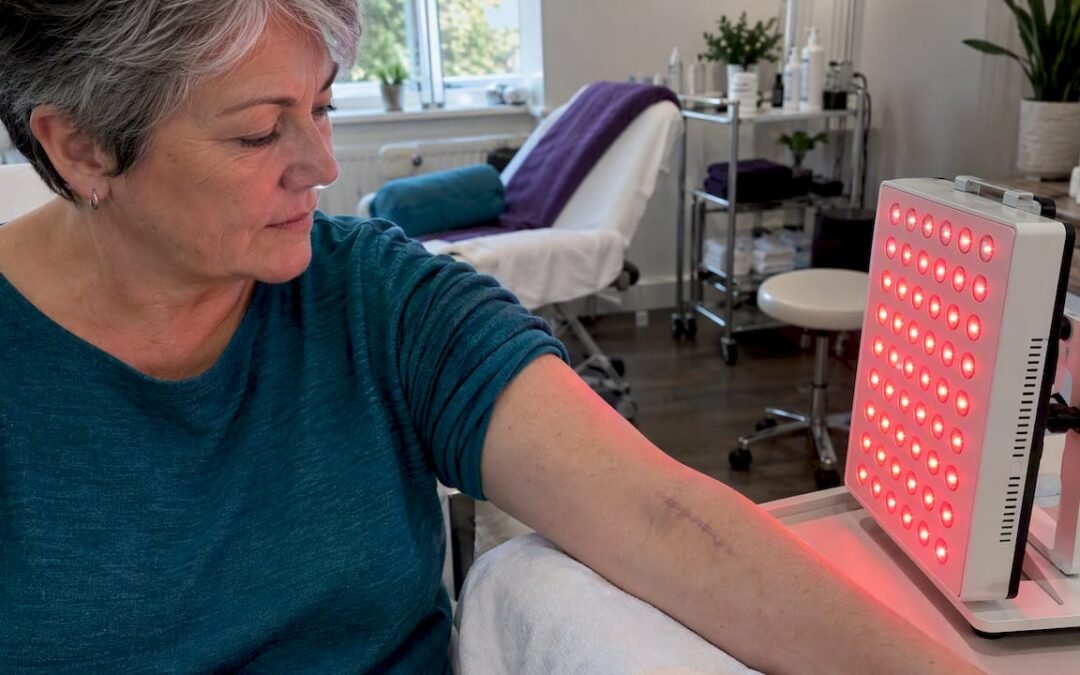
Red and near-infrared light can modestly improve some scar features, such as thickness, induration and pigmentation, mainly in scars under 12 months old. A 2026 scoping review and a dose-ranging split-face trial both report gains, but not every scar responds and results build slowly. For supervised sessions, see our red light therapy service.
TL;DR:
- Burn scars may improve in pigmentation and thickness, while postsurgical scars may become less firm.
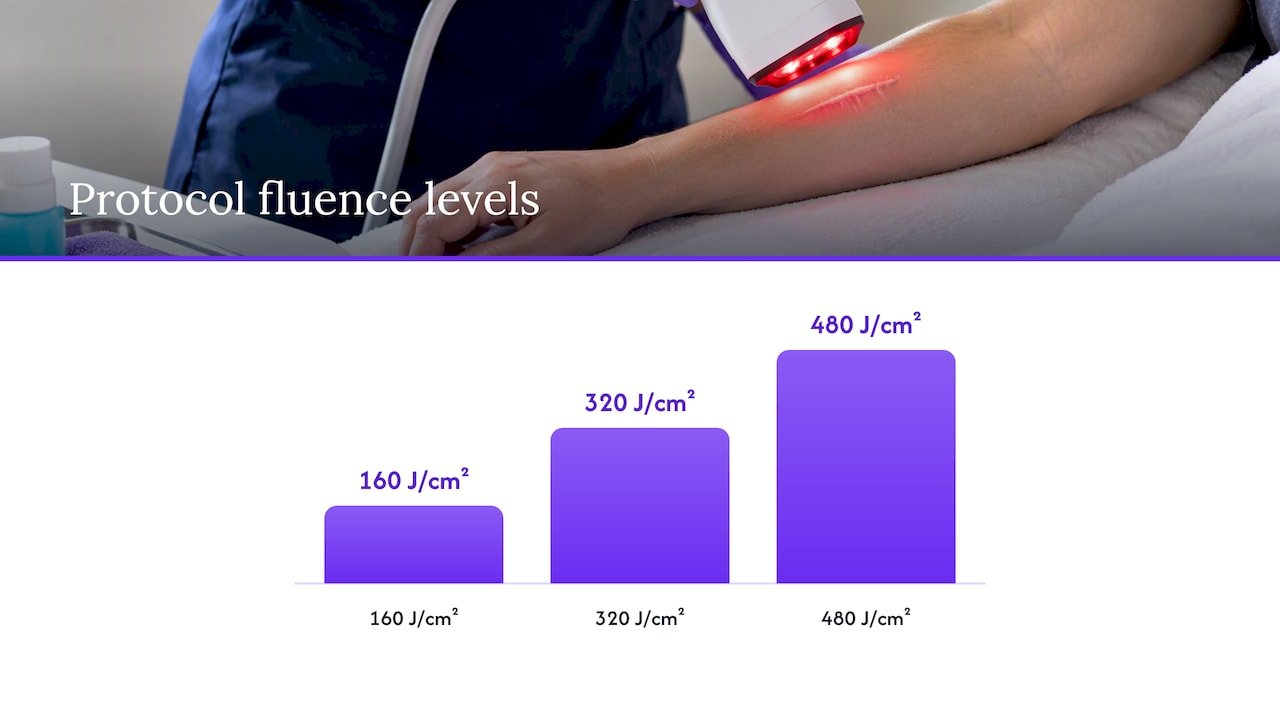
- A registered postsurgical trial tested 160, 320, or 480 J/cm² three times weekly for three weeks, beginning about one week after surgery.
- Moderate fluence often performed better than very low or very high doses, so device power alone cannot identify an effective treatment.
- Expect modest changes rather than scar removal; evidence remains limited, and established scars have less published support than recent scars.
- Red light can complement silicone care; compare photographs taken under consistent lighting at baseline and after 8 to 12 weeks to guide continuation.
Table of Contents
- What does the research actually show for scars?
- How do red and near-infrared light affect scar tissue?
- Which wavelengths and devices did the studies use?
- What dose and schedule did the trials use?
- Which scars improve, and how much change should you expect?
- What should you watch for with side effects, eye safety and contraindications?
- How does red light fit with silicone, lasers and injections?
- How do you decide between clinic and home, and track your progress?
- Our view on supervised red light for scars
- How do you book a red light session with us?
- FAQ
- Sources
What does the research actually show for scars?
The most useful recent overview is a 2026 scoping review of photobiomodulation (PBM) for scars. It looked at red light (633–670 nm) and near-infrared light (808–830 nm) and found clinical improvements in some scars, particularly those under 12 months old. The outcomes were measured with validated tools: the Vancouver Scar Scale (VSS) and the Patient and Observer Scar Assessment Scale (POSAS), along with induration (firmness) and pigmentation.
Here is what the reviewed evidence points to:
- Burn scars showed improved pigmentation and thickness, especially when they were under 12 months old.
- Post-surgical scars showed reduced induration.
- A biphasic dose-response appeared in several findings: moderate fluence tended to work better than very low or very high doses.
- Red LED and near-infrared light both produced positive clinical outcomes on scar scores.
The controlled evidence comes from a split-face, dose-ranging randomised controlled trial, “Light emitting diode-red light for reduction of post-surgical scarring”. Each person acted as their own comparison, with different areas of the scar treated at specified fluences and measured using validated scar outcomes. The registered protocol, NCT03795116, describes randomisation to fluences of 160, 320 or 480 J/cm², delivered three times weekly for three weeks, starting about a week after surgery. Its planned primary outcome was skin elasticity, measured with an ElastiMeter.
Scars under 12 months old were the group where the scoping review saw the clearest gains in pigmentation, thickness and induration. Older, established scars have less published support, so we treat them with more caution.
How strong is all of this? Promising, but not settled. A 2016 review of visible red LED photobiomodulation concluded it is a safe, non-invasive treatment that can influence fibroblast behaviour and collagen production, yet it also noted how few clinical trials existed. The picture has improved since, but the available evidence is still limited. Cleveland Clinic takes a similar line: red light shows promise for reducing scars, but more clinical trials are needed, and you should ask a healthcare provider whether it suits you.
For tracking ongoing studies, ClinicalTrials.gov lists registered protocols.
How do red and near-infrared light affect scar tissue?
The science behind this is called photobiomodulation. The 2016 review on skin fibrosis describes how visible red light may affect cellular pathways associated with skin fibrosis. In scar tissue, fibroblasts are among the cells involved in collagen production.
The 2016 review on skin fibrosis describes several pathways through which visible red light may act:
- Fibroblast activity: red light can modulate fibroblast behaviour, including reducing proliferation in laboratory settings.
- Pro-fibrotic signalling: red light may influence cellular pathways associated with skin fibrosis.
- Collagen production: in vitro work shows suppressed collagen synthesis, a plausible route to flatter, softer scars.
- Cellular tolerance: the review characterised LED red light as safe, portable and inexpensive compared with many alternatives.
An important caveat: much of this mechanism evidence comes from cell studies, so it explains why scar improvement is plausible without proving it on its own. The clinical trials above are what show whether it happens in people.
Dose matters too. The scoping review reports that moderate fluence levels were often most effective, which fits a biphasic response: too little light does little, and too much can blunt the benefit. That is why a bigger or brighter device is not automatically better.
Pro Tip: Think of dose as a “Goldilocks” setting. When you compare devices or clinic protocols, ask about the total energy delivered per session, not just how powerful the lamp sounds.
Which wavelengths and devices did the studies use?
The clinical work clusters around two bands. Studies have examined red light at 633–670 nm and near-infrared light at 808–830 nm for scar changes. Our own page on red light wavelengths explains how to read these ranges when you compare devices.
Device formats fall into two broad groups:
- Clinic devices: LED arrays and lasers, generally more powerful, and operated under supervision.
- At-home devices: LED panels, masks and wands. The American Academy of Dermatology notes that clinic devices are generally stronger than home ones, and that dermatologists usually use red light as a complementary therapy alongside other treatments.
Lower power at home does not mean no effect, but it does mean results depend more on consistency, distance from the skin and careful dosing. For a fresh post-surgical scar, clinician oversight matters more than device specifications.
If you are choosing a device or a provider, run through this checklist:
- Verified wavelength that matches the trial ranges (red 633–670 nm, near-infrared 808–830 nm).
- Stated irradiance (power density), so you can work out dose from session time.
- Safety features such as goggles, timers and automatic shut-off.
- Clear servicing and repair arrangements.
- Clinician oversight if the scar is recent, post-surgical or in a sensitive area.
A partner resource on photobiomodulation benefits and dosage offers helpful background on how clinic sessions are typically described and why dose is central to results.
What dose and schedule did the trials use?
The dose-ranging trial design gives us the clearest numbers. According to the registered protocol, NCT03795116, participants were assigned to 160, 320 or 480 J/cm², delivered three times weekly for three weeks, beginning about one week after surgery. Those are clinic-level doses, delivered under controlled conditions.
To translate dose into a session, remember the basic relationship: energy (J/cm²) equals irradiance (W/cm²) multiplied by time in seconds. If a device delivers a known irradiance at your skin, you can estimate how long a session needs to be. Our guide to red light therapy dosage explains how to measure irradiance and why measuring beats trusting a label.
A sensible way to plan, whether in clinic or at home:
- Confirm the scar’s age and type with a clinician, especially if it is post-surgical or from a burn.
- Choose wavelengths within the studied ranges.
- Establish the dose from the device’s measured irradiance and the session length, rather than guessing.
- Keep to a consistent schedule, such as the three-times-weekly pattern used in the trial protocol.
- Allow 8–12 weeks before judging the result, with photographs taken at the start and at each review.
In the registered dose-ranging protocol, treatment ran three times a week for three weeks at 160, 320 or 480 J/cm², starting roughly a week after surgery (NCT03795116).
Clinic protocols tend to use higher fluence over fewer weeks, while home regimens usually deliver lower fluence over a longer cumulative period. Neither is automatically better, because the biphasic response means more is not always more. If you are unsure, discuss the plan with a clinician rather than copying a number from the internet.
Which scars improve, and how much change should you expect?
The scars most likely to respond are recent ones. The scoping review highlights scars under 12 months old, in particular:
- Recent burn scars, with gains in pigmentation and thickness.
- Post-surgical scars, with reduced induration.
- Early-stage scars where remodelling is still under way.
Expect modest to moderate change on validated scales such as VSS and POSAS, not complete removal. A scar may become a little flatter, less firm or more even in colour, and the studies did not report dramatic transformations. That honesty matters, because the biggest source of disappointment with any scar treatment is an unrealistic picture of the end point.
A realistic timeline looks like this:
- First few weeks: subtle changes at most; some people notice softer texture first.
- Around 8–12 weeks: a sensible point to review progress with a clinician and decide whether to continue.
- Over several months: more meaningful change, as scar remodelling is a slow process.
Standardised photographs (same light, angle and distance, with a ruler in frame) make your own progress far easier to judge than memory does.
What should you watch for with side effects, eye safety and contraindications?
The 2016 review describes LED red light as a safe, non-invasive treatment. Even so, discuss its suitability with a healthcare professional before use.
- Ask a healthcare professional what side effects may apply to your situation.
- Ask your provider what eye precautions to follow for the device you use. Our red light eye safety guidance offers further information.
- Discuss whether red light therapy is appropriate for you with a healthcare professional before starting.
- Seek medical advice about any active infection or unexplained skin changes before considering treatment.
- Read our overview of red light therapy side effects for a fuller picture.
Pro Tip: Check with your GP or a dermatologist before starting, particularly for a fresh surgical scar or any scar that is changing, itching persistently or looks different from before. The American Academy of Dermatology advises consulting a board-certified dermatologist before at-home use.
How does red light fit with silicone, lasers and injections?
Red light works best as an add-on, not a replacement. Dermatology practice places it alongside established scar care rather than in front of it.
- Silicone sheeting and gels: NHS guidance on silicone for scars explains that silicone keeps scars at an optimal moisture level and can make them flatter, softer and paler, usually over months, with occasional local irritation. Red light can sit alongside this routine.
- Lasers: the AAD scar treatment guidance notes that lasers can substantially improve many scar features but need clinician skill, often combine with injectables, and may take several sessions with sun protection. Their patient advice on laser treatment adds that lasers cannot remove a scar completely.
- Injections: reserved for persistent hypertrophic or keloid scars, under medical supervision.
A clinician can advise whether red light, lasers or injections are appropriate and how to coordinate them. Always coordinate timing with your clinician. Sun protection after laser work, for instance, affects when other treatments make sense, and combining interventions without advice is not something we recommend.
How do you decide between clinic and home, and track your progress?
Start with a short decision checklist: how old the scar is (under 12 months is more likely to benefit), how severe it is, whether you can access supervised clinic devices, your budget, and whether you need medical oversight. For a recent post-surgical scar, supervised treatment usually makes sense. For a long-standing, stable scar, a home routine may be a reasonable low-stakes experiment once a clinician has looked at it.
Before you commit to a provider, ask these questions:
- Which wavelengths do you use, and are they within the studied ranges?
- What fluence do you deliver per session, and how is it measured?
- How many sessions are typical, and how often?
- How will you monitor my scar and decide when to stop or change course?
- What eye protection and aftercare do you provide?
Track progress with:
- Standardised photographs with a ruler, taken in the same place and light each time.
- Short notes on redness, thickness and pliability.
- A review at 8–12 weeks to decide whether to continue or escalate.
Pro Tip: Take your “before” photographs on the first day, before the first session. Later comparisons are the single most honest way to tell whether the treatment is doing anything.
If you want a wider primer first, our complete guide to red light therapy in Ireland covers the basics.
Our view on supervised red light for scars
We think red light earns its place in scar care when it is used with realistic expectations and a clinician in the loop. For suitable candidates, particularly people with recent scars, we recommend supervised sessions because dose, wavelength and eye protection are managed for you, and progress is checked at sensible intervals instead of left to guesswork. Our approach is evidence-informed: we monitor, we adjust, and we never promise a scar will disappear. It can sit alongside our other therapies, such as hyperbaric oxygen, where that suits you. Results vary from person to person, so we are happy to talk through your scar and what is realistic.
— Mark
How do you book a red light session with us?
A typical session is straightforward: you relax while the treated area is exposed to red light for a set time. Red light therapy at our centre is priced at €20–40 per session, as listed on our red light therapy page, where you can read more and arrange a booking. If you would like to combine sessions with other therapies, such as hyperbaric oxygen or holistic massage, you can ask about those when you book.

Ready to talk through your scar? Visit our red light therapy page to check availability and book your first session.
This article is general information, not a substitute for advice from a qualified doctor. Consult a qualified healthcare professional about your own circumstances before acting on anything here.
FAQ
Does red light help heal scars?
It may help some scars, particularly recent ones. A 2026 scoping review found improvements in pigmentation, thickness and induration in some scars under 12 months old. Results are modest, and not every scar responds.
What colour LED light is best for scars?
Studies have used red light at 633–670 nm and near-infrared light at 808–830 nm. Near-infrared penetrates deeper, while red acts nearer the surface. Which is better depends on the scar, so a clinician can advise on your case.
What is the downside of red light therapy?
The usual downsides are mild and temporary, such as redness or itching, plus the need for consistency over weeks. The bigger limit is evidence: Cleveland Clinic notes more clinical trials are needed, so results are not guaranteed.
Can LED light help with scar healing?
LED light can support scar remodelling in some cases. A dose-ranging randomised trial tested LED red light on post-surgical scars using validated measures. Used alongside silicone and medical advice, it is a reasonable adjunct.
Sources
- Pubmed
- Light emitting diode-red light for reduction of post-surgical …
- Visible Red Light Emitting Diode Photobiomodulation for Skin Fibrosis: Key Molecular Pathways
- Red Light Therapy: Benefits, Side Effects & Uses